Microsoft Dynamics GP Is Retiring: Everything
Businesses Need to Know in 2026
The April 1, 2026 deadline has passed. New Dynamics GP subscription licenses can no
longer be purchased. If your business is still running GP, now is the time to plan your next move not after mainstream support ends in 2029.
A Product That Served Businesses for Over 30 Years Is Winding Down
Microsoft Dynamics GP originally known as Great Plains has been one of the most widely
adopted ERP and financial management platforms for mid-sized businesses since the early
1990s. For thousands of organizations across the USA, Australia, and globally, it has been the
backbone of accounting, payroll, inventory, and HR operations for decades.
That era is drawing to a close.
In September 2024, Microsoft officially announced the end-of-life timeline for Dynamics GP.
The first major deadline, the end of new perpetual license sales passed in April 2025. The
second deadline, ending subscription license sales, passed on April 1, 2026. The product is now
in a managed wind-down phase, and businesses that have not yet started planning their
transition need to start now.
This blog sets out the complete timeline, the real risks of waiting, the migration options
available, and the practical steps organizations should take in 2026.
The Complete Dynamics GP Retirement Timeline
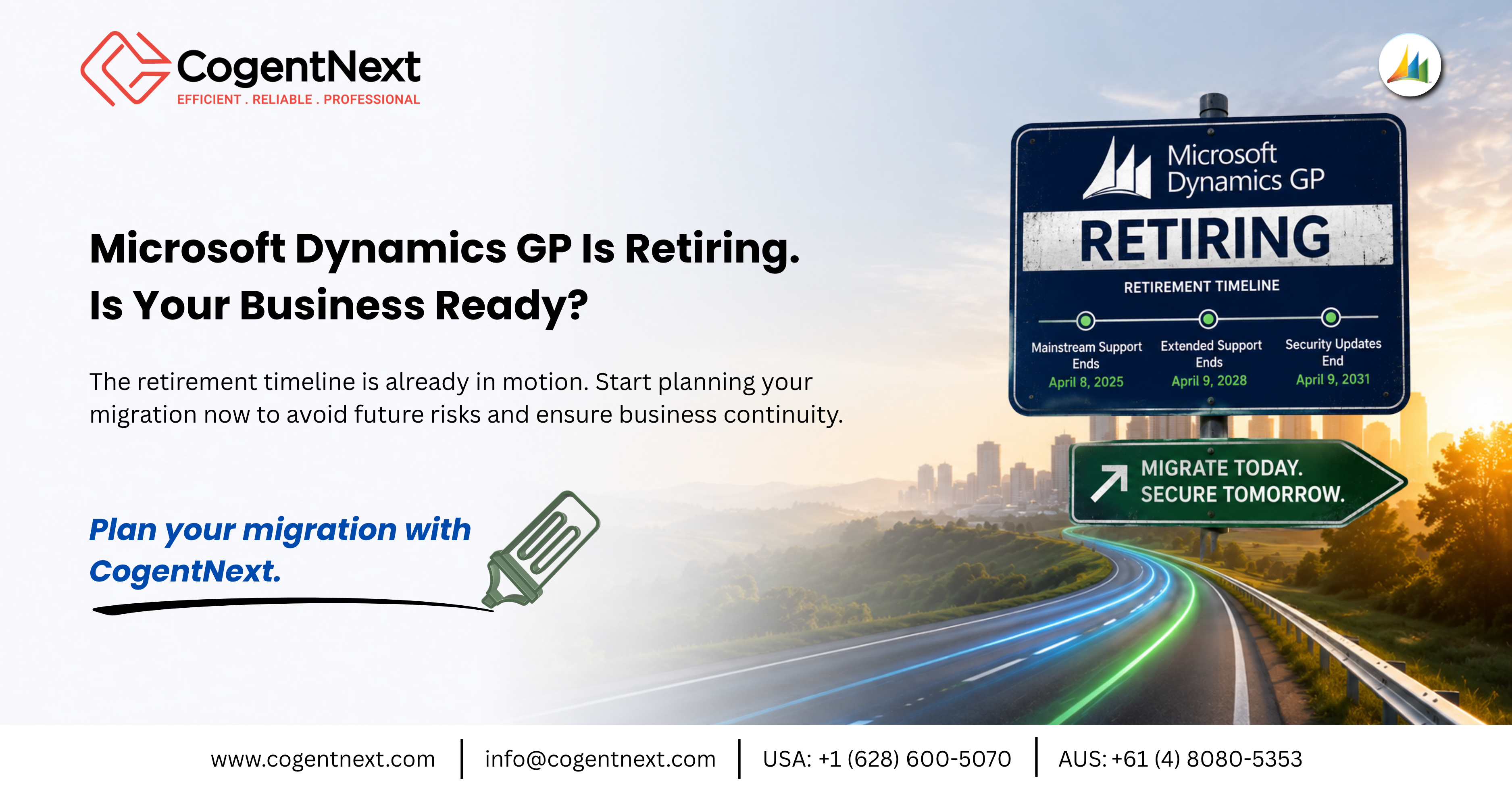
Microsoft has published a clear, global sunset schedule for Dynamics GP. These dates apply to
all markets includes USA, Australia, India, and worldwide:
- April 1, 2025 (Passed) – End of sales for new perpetual licenses. No new customers can
purchase owned GP licenses. - April 1, 2026 (Passed) – End of sales for new subscription licenses. The final door for
any new customer acquisition is now closed. - December 2028 – Final year-end update for Dynamics GP. The last tax and regulatory
update Microsoft will deliver. - December 31, 2029 – End of mainstream support. No more product enhancements,
regulatory tax updates, service packs, or technical support from Microsoft. - April 30, 2031 – End of all security updates. The official hard stop – after this date, the
software will be fully vulnerable to new cyber threats with no patches available from Microsoft.
Existing customers can still use Dynamics GP and can still add users to their current instances
after the sales cutoff dates. The software does not stop working. But the risk profile grows
every year as Microsoft reduces investment, regulatory updates stop, and the talent pool of GP
consultants continues to shrink.
Why 2026 Is the Right Year to Act Not 2029
Many organizations look at the 2029 and 2031 dates and conclude there is no urgency. That
reasoning underestimates the compounding risks of delay.
Feature Development Already Stopped in 2022
Microsoft announced in November 2022 that the October 2022 release would be the final
release with major feature updates for Dynamics GP. The product has been in maintenance
only mode for over three years. While Business Central ships two major updates per year, GP
users have been operating on a frozen platform every month the capability gap between GP
and modern cloud ERP widens.
The Talent Market Is Already Shifting
As Microsoft shifts investment entirely toward Business Central and Dynamics 365 Finance, the
consultants, ISVs, and third-party add-on vendors who support Dynamics GP are increasingly
pivoting their practices to cloud platforms. The pool of qualified GP implementation and
support specialists is contracting and will continue to do so regardless of the official support
dates. Organizations that wait until 2028 or 2029 to begin their migration will find the partner
ecosystem significantly thinner than it is today.
Migrations Take Longer Than Expected
A typical Dynamics GP to Business Central migration takes six to twelve months for a standard
environment. Organizations with complex customizations, multiple entities, or heavily
integrated third-party add-ons should plan for longer. Starting in 2026 provides the most
comfortable runway starting in 2028 or 2029 means rushing a migration under deadline
pressure, which is where cost overruns and operational disruption happen.
Organizations that begin planning early are better positioned to modernize strategically rather
than reactively. The difference between a well-planned migration and a rushed one is
measured in both cost and operational risk.
What Happens If You Stay on Dynamics GP Past 2029 ?
Staying on Dynamics GP beyond the mainstream support end date in December 2029 is
technically possible the software will continue to run. But the practical consequences are
significant:
- No tax or regulatory updates – Organizations using GP for payroll or financial reporting
in regulated industries will need to manage tax table updates manually or through third
party vendors. In Australia and the USA, where payroll compliance requirements change
annually, this becomes a significant operational burden. - No security patches – From 2031, the software will be fully exposed to new
vulnerabilities with no official remedy from Microsoft. Running an unpatched ERP
system that contains financial, payroll, and customer data creates material cybersecurity
and compliance risk. - Growing integration challenges – Modern cloud applications, payment systems, e
commerce platforms, and HR tools are increasingly built for API-first integration.
Maintaining integrations between these systems and an aging on-premises GP
environment becomes progressively more expensive and fragile. - Compliance exposure – In Australia, GDPR-adjacent privacy obligations and ATO
reporting requirements; in the USA, state-level payroll and financial reporting
compliance – all depend on the ERP staying current. A system no longer receiving
regulatory updates creates growing compliance risk in both markets.
Your Migration Options: What to Move To ?
Option 1: Microsoft Dynamics 365 Business Central (Recommended for Most GP
Users)
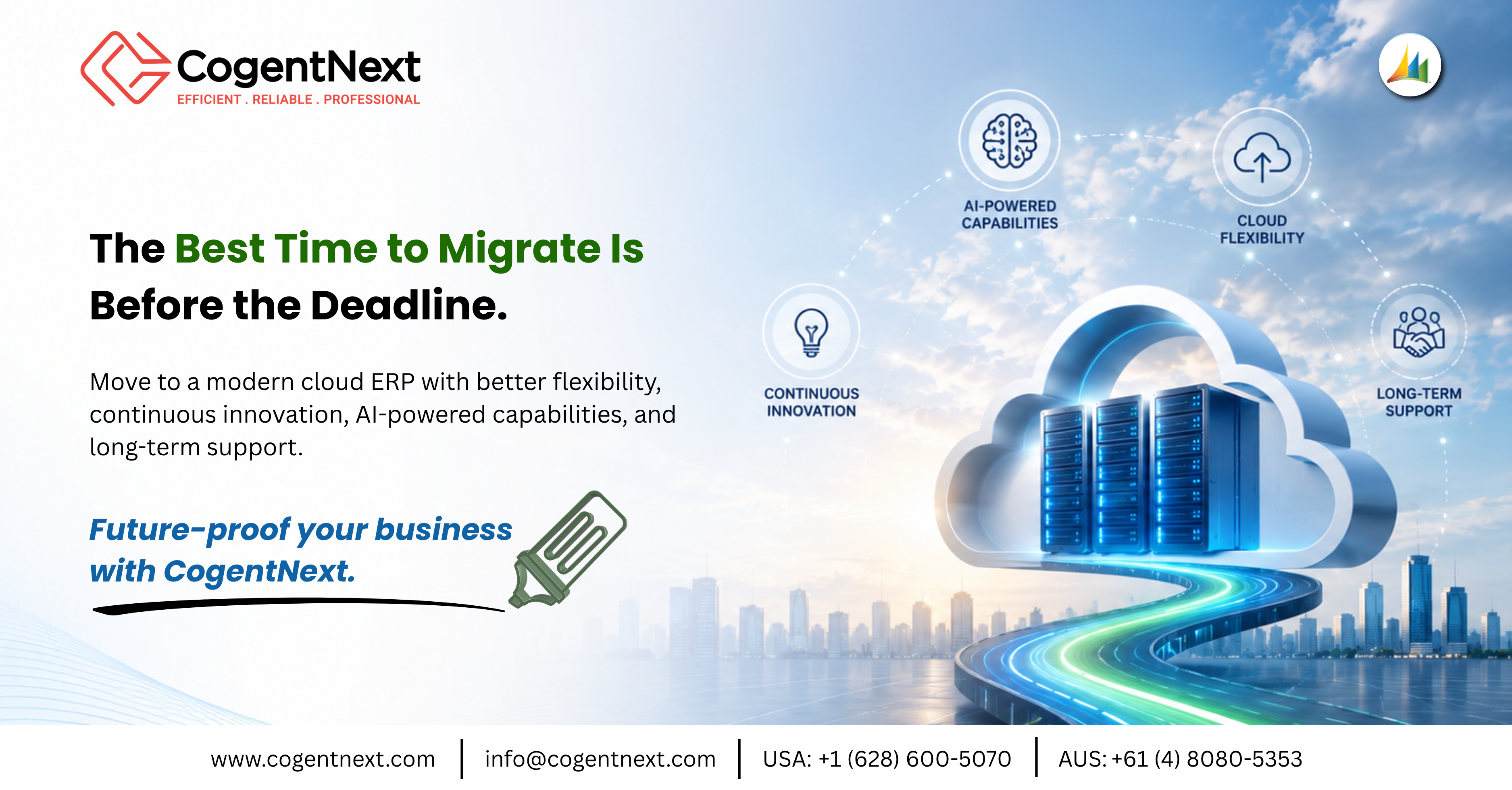
Business Central is Microsoft’s officially recommended successor to Dynamics GP a cloud
native ERP designed for the same small-to-mid-market audience that GP has served for
decades. Microsoft has invested heavily in structured migration tooling specifically for GP-to
Business-Central transitions, including data migration tools that move financial data, customer
records, vendors, and historical transactions with minimal disruption.
For organizations already in the Microsoft ecosystem using Microsoft 365, Teams, Power BI,
or Azure Business Central integrates natively and delivers Copilot AI capabilities, continuous
updates, and a browser-based interface accessible from any device.
- Native integration with Microsoft 365, Teams, Power BI, and Azure
- Copilot AI for financial forecasting, reporting, and workflow automation
- Two major updates per year – continuous innovation versus GP’s frozen feature set
- Bridge to Cloud 3 promotion – 30% discount on Dynamics 365 cloud licenses through
December 2027, with dual access rights allowing parallel GP and Business Central
operation during transition.
Option 2: Dynamics 365 Finance and Supply Chain Management
For larger organizations with more complex multi-entity structures, advanced supply chain
requirements, or enterprise-scale operations, Dynamics 365 Finance and Supply Chain
Management offers a more comprehensive platform. This is the appropriate path for GP users
whose operations have grown beyond what Business Central is designed to handle.
Option 3: Evaluate Alternatives
Some organizations use the GP sunset as an opportunity to evaluate non-Microsoft platforms.
Oracle NetSuite, SAP Business One, and Sage Intacct are all viable alternatives for mid-market
businesses. The right choice depends on your transaction volumes, customization footprint,
integration landscape, and growth plans. CogentNext advises across all these platforms and can
provide an unbiased assessment.
The Bridge to Cloud 3 Promotion: Act Before End of 2027
Microsoft’s Bridge to Cloud 3 (BTC3) promotion launched at the start of 2026 and runs through
December 31, 2027. It offers:
- 30% discount on Dynamics 365 cloud licenses locked in for a three-year term
- Dual access rights – the ability to keep running your on-premises GP environment
while standing up and validating your new cloud environment in parallel - Structured migration support – access to Microsoft’s cloud migration tools and
partner-led implementation resources.
For GP customers planning to migrate to Business Central or Dynamics 365 Finance, the
BTC3 promotion makes the financial case significantly stronger. Locking in a 30%
discount on a three-year term before end of 2027 is a meaningful cost difference at any
seat count.
What to Do Right Now: A Practical Starting Point
For organizations currently running Dynamics GP, here are the immediate steps that matter
most in 2026:
- Assess your current GP environment – Identify your GP version, customization
footprint, third-party add-on dependencies, and data volumes. This assessment is the
foundation of every migration decision. - Identify your compliance-critical processes – Payroll, tax reporting, and financial
compliance are the highest-risk areas when regulatory updates stop in 2029.
Understand which GP processes carry the most compliance exposure. - Review the Bridge to Cloud 3 promotion – If Business Central is the likely destination,
model the three-year cost comparison before the BTC3 window closes at end of 2027. - Engage a migration partner – Migrations that are scoped and planned with an
experienced partner consistently outperform those managed internally. The earlier you
engage, the more options you have on timing, phasing, and cost. - Don’t wait for the 2029 deadline – Every year of delay narrows your options, reduces
the GP partner ecosystem, and increases the risk that your migration is driven by a
deadline rather than a strategy.
How CogentNext Can Help ?
CogentNext has deep expertise across the full Microsoft Dynamics ecosystem — including
legacy platforms like Dynamics GP and the modern cloud platforms that succeed them. We
work with organizations in Australia, the USA, and India to assess their current Dynamics GP
environments, evaluate migration options, and execute transitions to Business Central or
Dynamics 365 Finance with minimal operational disruption.
Whether your organization is just beginning to think about the GP transition or is ready to start
scoping a migration project, our team provides the technical depth and practical experience to
guide the process from assessment to go-live.
Contact the CogentNext team for a Dynamics GP readiness assessment and find out what
migration path makes most sense for your environment, timeline, and budget.
Get in touch with us:
www.cogentnext.com
Email: info@cogentnext.com
USA: +1 (628) 600-5070
AUS: +61 (4) 8080-535