
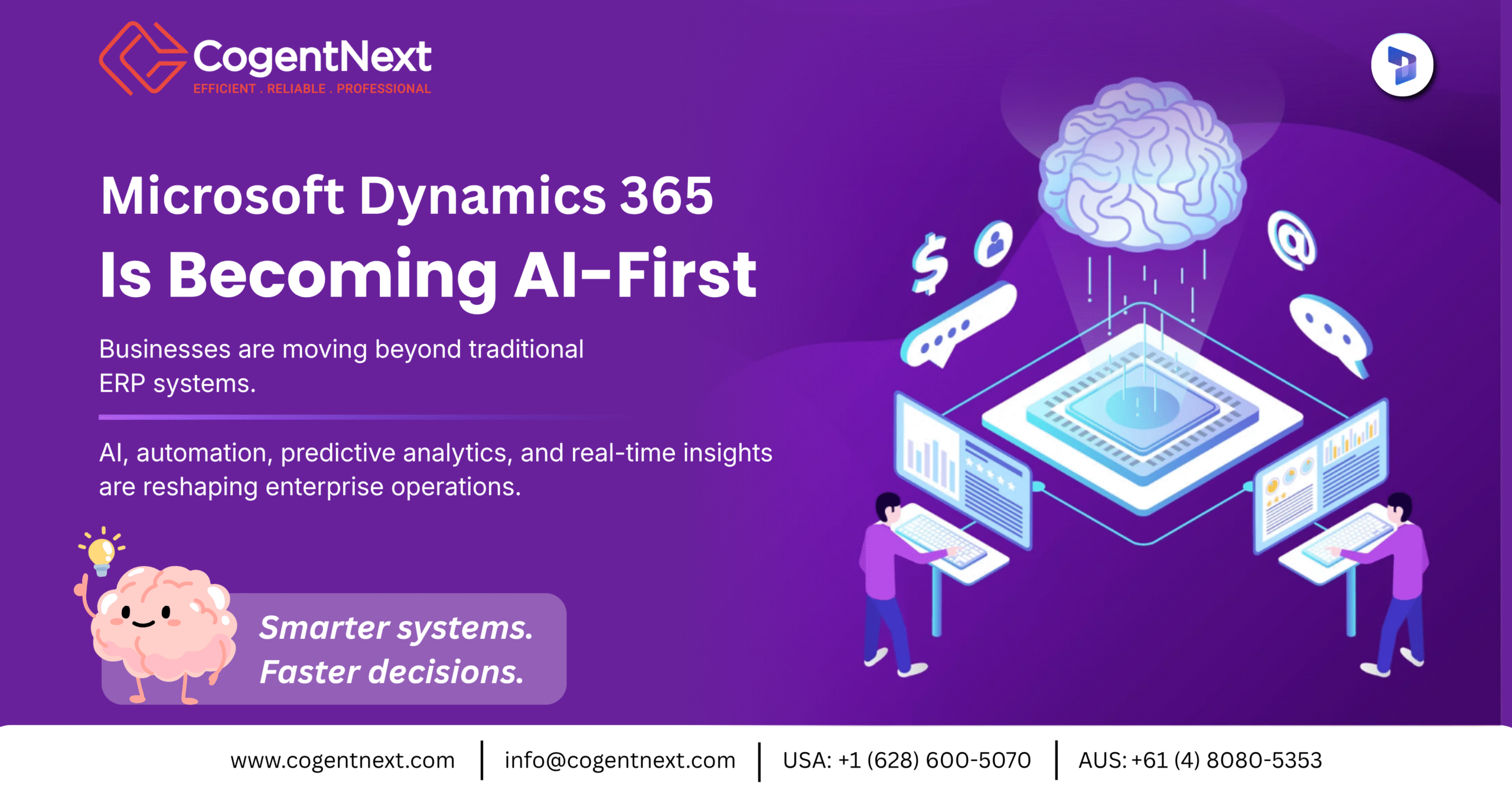
Microsoft Dynamics 365 Trends Businesses Should Watch
In today’s rapidly evolving digital economy, businesses are under more pressure than ever to operate smarter, faster, and more efficiently. Customer expectations are rising, competition is intensifying, and enterprises are generating massive volumes of data every single day. Traditional ERP and CRM systems that once focused only on record keeping and transaction management are no longer enough to meet modern business demands.
Organizations today need intelligent business platforms that can automate operations, deliver real-time insights, improve customer engagement, and support agile decision-making across departments. This is where Microsoft Dynamics 365 has emerged as one of the most powerful enterprise transformation platforms in the modern business ecosystem.
Over the last few years, Dynamics 365 has evolved significantly from being just an ERP and CRM solution into a comprehensive intelligent business platform powered by cloud computing, artificial intelligence, automation, predictive analytics, and deep integration capabilities.
As Microsoft continues investing heavily into AI-native enterprise experiences, businesses using Dynamics 365 are entering a completely new era of digital transformation.
The future of enterprise systems is no longer simply about managing processes. It is about creating connected, intelligent, and self-optimizing business ecosystems.
For organizations planning their digital transformation journey, understanding the latest Microsoft Dynamics 365 trends is essential for staying competitive in 2025 and beyond.
1. AI-Powered Copilot Experiences Are Transforming Enterprise Workflows
Artificial Intelligence is no longer an experimental technology limited to innovation labs. It has now become deeply integrated into mainstream enterprise operations.
One of the biggest developments within Microsoft Dynamics 365 is the expansion of Microsoft Copilot capabilities across ERP, CRM, customer service, finance, operations, sales, and supply chain management.
Microsoft is moving beyond traditional automation into AI-assisted and AI-driven business operations.
Dynamics 365 Copilot acts as an intelligent assistant capable of helping employees:
- Generate reports instantly
- Summarize customer interactions
- Predict sales opportunities
- Draft emails and responses
- Analyze operational data
- Provide financial insights
- Automate repetitive administrative tasks
- Recommend next-best actions
Instead of employees manually searching through dashboards, reports, or spreadsheets, AI can now surface relevant insights proactively.
This significantly improves:
- Productivity
- Decision-making speed
- Employee efficiency
- Customer responsiveness
- Operational agility
Businesses are increasingly recognizing that AI is not replacing employees, it is enhancing their capabilities and helping teams focus on higher-value strategic work.
For example, sales teams can use AI-generated opportunity insights to prioritize leads more effectively. Finance teams can automate reconciliation processes and identify anomalies faster. Customer support teams can respond to customer issues with AI-generated recommendations and contextual information.
The impact of these capabilities is substantial because businesses are no longer relying solely on historical data analysis. They are moving toward predictive and proactive business operations.
As Microsoft continues expanding AI capabilities across Dynamics 365, organizations that adopt these technologies early are likely to gain significant competitive advantages.
2. Hyperautomation Is Becoming the New Standard
Businesses are now entering the era of hyperautomation.
Traditional automation focused mainly on digitizing repetitive workflows. Hyperautomation goes much further by combining:
- Artificial Intelligence
- Robotic Process Automation (RPA)
- Machine Learning
- Workflow orchestration
- Predictive analytics
- Intelligent process management
Dynamics 365 integrated with Microsoft Power Platform allows businesses to automate complex workflows across departments and systems.
Modern enterprises are now automating:
- Invoice approvals
- Vendor onboarding
- Procurement processes
- Inventory management
- Customer support routing
- HR onboarding workflows
- Compliance reporting
- Financial reconciliations
- Sales pipeline management
The objective is not simply to reduce manual work.
The real goal is to create intelligent operational ecosystems that can continuously optimize themselves over time.
Hyperautomation provides businesses with several major advantages:
Improved Operational Efficiency
Manual processes often create delays, bottlenecks, and inconsistencies. Intelligent automation helps reduce turnaround time and improves process reliability.
Reduced Human Error
Automated workflows significantly minimize errors caused by repetitive manual tasks.
Faster Scalability
Businesses can scale operations without proportionally increasing operational overhead.
Better Resource Allocation
Employees spend less time on repetitive administrative work and more time on strategic initiatives.
Increased Business Agility
Automated systems allow businesses to respond faster to market changes and operational demands.
As enterprises continue modernizing operations, hyperautomation will become one of the most critical components of future-ready business infrastructure.
3. Predictive Analytics Is Driving Smarter Decision-Making
One of the biggest transformations happening within enterprise systems is the shift from reactive operations to predictive intelligence.
Traditional ERP systems primarily focused on recording transactions and generating reports based on past performance.
Modern businesses now expect enterprise systems to:
- Predict future trends
- Identify risks early
- Recommend actions
- Optimize operations proactively
Dynamics 365 is increasingly leveraging AI-powered predictive analytics to help organizations make smarter decisions faster.
Businesses can now use predictive analytics to:
- Forecast customer demand
- Predict inventory shortages
- Analyze financial risks
- Improve revenue forecasting
- Identify customer churn risks
- Detect operational inefficiencies
- Optimize supply chain planning
This trend is especially valuable in industries where operational speed and forecasting accuracy directly impact profitability.
For example:
- Retail companies can forecast seasonal demand more accurately.
- Manufacturing firms can predict supply chain disruptions.
- Healthcare organizations can optimize patient scheduling and resource allocation.
- Financial institutions can identify anomalies and compliance risks earlier.
The future of enterprise management is increasingly data-driven.
However, businesses are also realizing that having data alone is not enough.
The true value lies in converting data into actionable intelligence.
This is exactly where Dynamics 365 continues evolving rapidly.
4. Industry-Specific ERP and CRM Solutions Are Growing Rapidly
Modern enterprises no longer want generic enterprise software platforms.
Businesses are increasingly demanding industry-specific solutions tailored to their operational needs, compliance requirements, and customer engagement models.
This trend is driving the rise of vertical-focused Dynamics 365 implementations.
Organizations across industries such as:
- Manufacturing
- Healthcare
- Retail
- Logistics
- Finance
- Construction
- Professional services
- Education
are adopting customized ERP and CRM ecosystems designed specifically for their operational environments.
Industry-specific solutions help businesses:
- Reduce implementation complexity
- Accelerate deployment timelines
- Improve user adoption
- Enhance reporting accuracy
- Meet compliance requirements more effectively
For example:
- Healthcare providers require patient-centric workflows and compliance-focused systems.
- Manufacturing companies need advanced supply chain visibility and production planning tools.
- Retail businesses require omnichannel customer engagement capabilities.
- Logistics firms need real-time tracking and operational coordination.
The future of ERP is moving away from “one-size-fits-all” systems toward intelligent, industry-adaptive platforms.
5. Cloud-First ERP Adoption Continues to Accelerate
Cloud adoption is no longer a future trend, it has become the foundation of modern enterprise technology.
Businesses are rapidly moving away from traditional on-premise infrastructure toward cloud-native enterprise systems.
Dynamics 365’s cloud architecture provides organizations with:
- Scalability
- Remote accessibility
- High availability
- Faster deployments
- Automatic updates
- Reduced infrastructure costs
- Improved disaster recovery
- Enhanced security capabilities
The rise of hybrid work environments has further accelerated cloud adoption.
Modern employees expect access to business systems from anywhere, at any time, across multiple devices.
Cloud-native ERP and CRM platforms enable businesses to support distributed teams while maintaining operational continuity.
Another major advantage is agility.
Traditional ERP upgrades often required significant downtime, hardware investments, and lengthy deployment cycles.
Cloud-based systems now allow organizations to innovate continuously without major disruptions.
Businesses that delay cloud modernization may struggle to compete with organizations operating on agile, scalable digital infrastructures.
6. Unified Business Ecosystems Are Becoming Essential
Modern enterprises operate using multiple business applications across departments.
However, disconnected systems create:
- Data silos
- Communication gaps
- Duplicate processes
- Reporting inconsistencies
- Operational inefficiencies
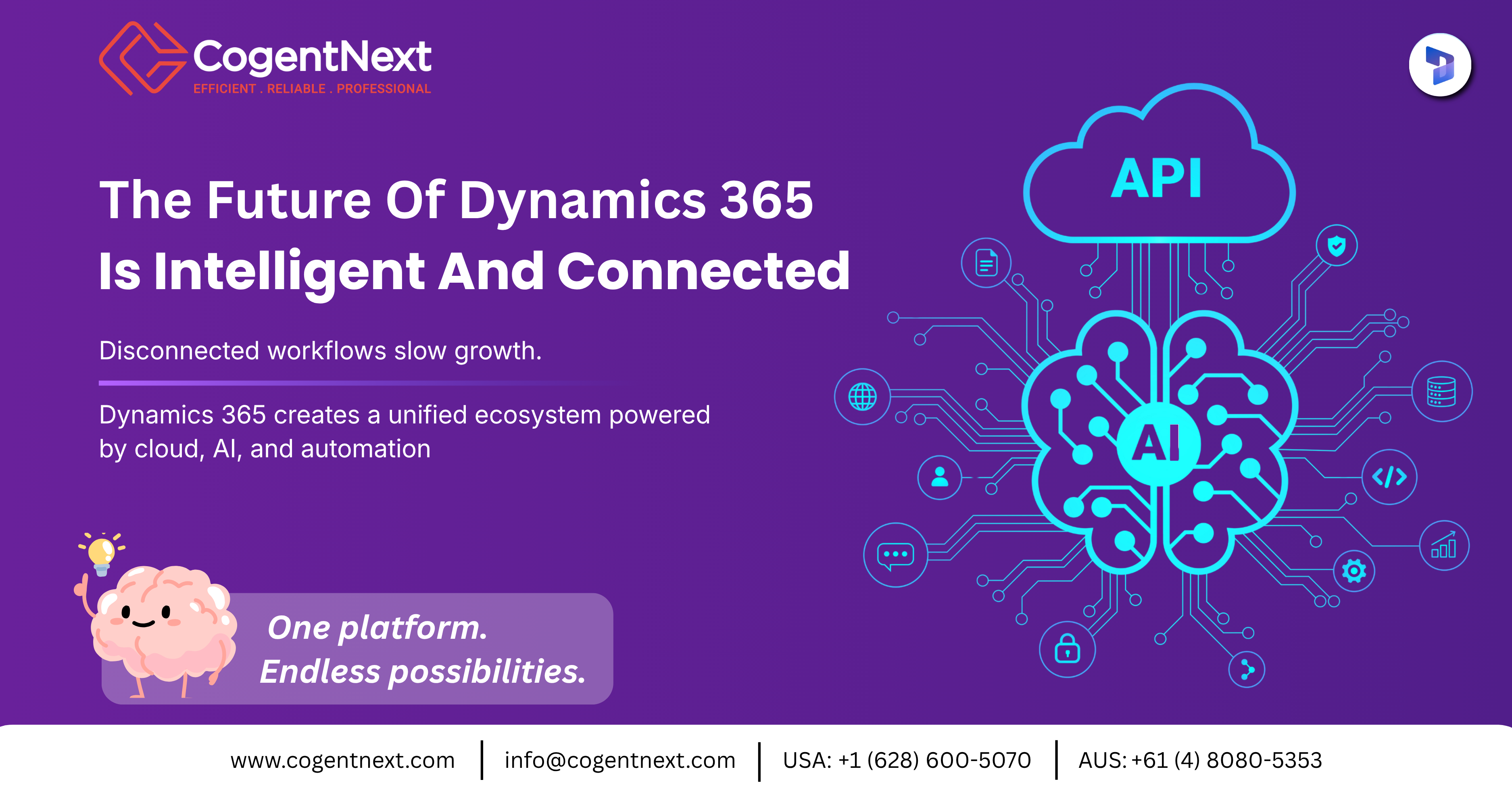
One of the major trends in Dynamics 365 is the creation of fully integrated business ecosystems.
Dynamics 365 integrates seamlessly with:
- Microsoft Teams
- Power BI
- Outlook
- Azure
- SharePoint
- Power Automate
- Microsoft 365
- Third-party enterprise applications
This allows businesses to create centralized operational environments where information flows in real time across departments.
The result is:
- Better collaboration
- Faster approvals
- Improved productivity
- Greater operational visibility
- More informed decision-making
Unified digital ecosystems are becoming essential because businesses can no longer afford fragmented operations in fast-moving markets.
7. Customer Experience Is Becoming More Intelligent and Personalized
Customer expectations have evolved dramatically over the last few years.
Modern customers expect:
- Faster responses
- Personalized experiences
- Proactive engagement
- Omnichannel communication
- Seamless interactions
Dynamics 365 Customer Insights and CRM capabilities are helping businesses create more intelligent customer engagement strategies.
AI-powered customer intelligence enables organizations to:
- Understand customer behaviour patterns
- Predict customer needs
- Personalize marketing campaigns
- Improve service experiences
- Increase customer retention
- Enhance sales engagement
Businesses are increasingly recognizing that customer experience is now a major competitive differentiator.
Companies that fail to modernize customer engagement strategies risk losing market relevance.
8. Security, Governance, and Compliance Are Becoming Strategic Priorities
As organizations adopt AI, automation, and cloud infrastructure, concerns around security and governance are also increasing rapidly.
Businesses now require enterprise platforms capable of providing:
- Advanced cybersecurity
- Data governance
- Compliance management
- Identity protection
- Access control
- AI governance
Microsoft continues investing heavily in enterprise-grade security and compliance capabilities within Dynamics 365 and Azure ecosystems.
Security is no longer viewed solely as an IT function.
It has become a strategic business priority because operational disruptions, data breaches, and compliance failures can significantly impact business continuity and reputation.
Organizations modernizing enterprise systems must ensure that innovation is balanced with governance and operational resilience.
9. The Rise of Autonomous Enterprise Operations
One of the most exciting developments in enterprise technology is the emergence of autonomous business operations.
AI-powered systems are gradually moving from assistive roles toward semi-autonomous operational capabilities.
Future Dynamics 365 ecosystems are expected to:
- Detect operational issues automatically
- Recommend corrective actions
- Optimize workflows dynamically
- Handle repetitive operational decisions
- Improve forecasting continuously
This shift represents a major transformation in how businesses operate.
Enterprise systems are evolving from passive software platforms into intelligent operational partners.
Businesses that successfully adopt autonomous operational models will likely achieve:
- Faster execution
- Lower operational costs
- Better scalability
- Improved responsiveness
- Greater competitive agility
Final Thoughts
Microsoft Dynamics 365 is evolving into far more than a traditional ERP or CRM platform.
It is becoming a fully connected intelligent enterprise ecosystem powered by:
- Artificial Intelligence
- Cloud computing
- Predictive analytics
- Automation
- Real-time collaboration
- Intelligent workflows
Businesses that understand and adopt these trends early will be better positioned to:
- Improve operational efficiency
- Deliver superior customer experiences
- Scale more effectively
- Reduce costs
- Accelerate innovation
- Strengthen long-term competitiveness
The future of enterprise technology is not just digital.
It is intelligent, connected, predictive, and autonomous.
At CogentNext, we help businesses modernize operations with future-ready ERP, CRM, cloud, AI, and digital transformation solutions tailored to evolving enterprise needs.
info@cogentnext.com
www.cogentnext.com
USA: +1 (628) 600-5070
AUS: +61 (4) 8080-5353