
The Agentic AI Governance Gap: Why Enterprises Are Deploying AI Agents Faster Than They Can Govern Them
AI agents are no longer confined to answering questions. Across finance, sales, and supply chain teams, they’re approving invoices, updating CRM records, and triggering workflows on their own. That’s the defining shift of 2026: AI has moved from advising to acting.
But adoption is outpacing oversight. Recent industry research points to a widening gap between how fast enterprises are rolling out agentic AI and how prepared they are to govern it. If your organization is exploring AI agents in ERP or CRM, this gap deserves attention before go-live, not after. If you’re new to the concept, our AI services overview is a good place to start.
This isn’t a call to slow down AI adoption. It’s a reminder that speed and control aren’t opposites, they’re both achievable, but only if governance is treated as part of the rollout plan rather than a follow-up task for later.
What Makes Agentic AI Different?
Traditional AI tools produce an output, a summary, a prediction, a recommendation, and a human decides whether to act on it. Agentic AI inverts that relationship. It receives a goal, plans the steps, selects the tools, and executes across business systems, often without pausing for approval.
This shift changes the nature of the risk. The question is no longer just “is this output accurate?” It’s “was this action authorized?”
Where the Governance Gap Shows Up
Enterprises rolling out agents quickly, and separately, tend to run into the same blind spots:
- No clear authority boundary — who approved this agent to modify financial records, send customer communications, or adjust inventory?
- No audit trail — if an agent takes a wrong or harmful action, can you trace back why it happened?
- Siloed deployment — sales, finance, and operations teams spin up agents independently, with no shared visibility into what’s acting autonomously across the business.
- Static, training-time controls — bias testing and data quality checks were built for models that advise, not agents that act on live systems.
None of this means agentic AI should be avoided. It means AI agent governance has to be designed alongside deployment, not bolted on afterward.
What’s Already Happening in Your ERP Stack?
This isn’t theoretical. Agentic AI is already live inside the platforms most enterprises run on:
- Oracle Fusion Cloud HCM now runs teams of specialized AI agents to manage scheduling, absences, timecards, and payroll.
- Microsoft Copilot is embedded in Business Central and Finance & Operations, increasingly handling invoice coding, sales-order entry, and master-data search.
- Salesforce and Oracle NetSuite offer similar agentic patterns across CRM and financial workflows.
Each of these represents a productivity win, and each one is a new point where an autonomous system touches real business data without a human in the loop.
A Realistic Scenario
Consider a mid-sized distribution company running Dynamics 365 Finance & Operations. Its finance team enables an AI agent to auto-match incoming vendor invoices against purchase orders and post approved ones directly to the general ledger, a genuinely useful, well-scoped automation.
Six months later, someone on the procurement side quietly asks the same agent to also flag and auto-approve routine reorders under a certain dollar threshold, extending its reach without a formal review. Around the same time, a sales operations lead configures a separate CRM agent to auto-update customer credit limits based on payment history.
Individually, each change seems reasonable. Together, three different agents are now making financial decisions across three systems, and no single person or team has visibility into all three. This is exactly how governance gaps form, not through one reckless decision, but through several sensible ones made without a shared view of the whole picture.
Why This Matters Beyond Internal Risk
For businesses operating across India, Australia, and the US, the governance conversation isn’t purely internal. Data protection and financial-reporting regulations differ by region, and an AI agent that autonomously moves or modifies data across borders can create compliance exposure that wasn’t relevant when a human was making each decision manually.
Auditors and regulators are also starting to ask more specific questions about AI-driven decisions, not just whether a process is accurate, but whether it can be explained and traced. Enterprises that can already answer “which agent did this, and why” will have a materially easier time in that conversation than those piecing it together after the fact.
Closing the Gap: A Governance-First Approach
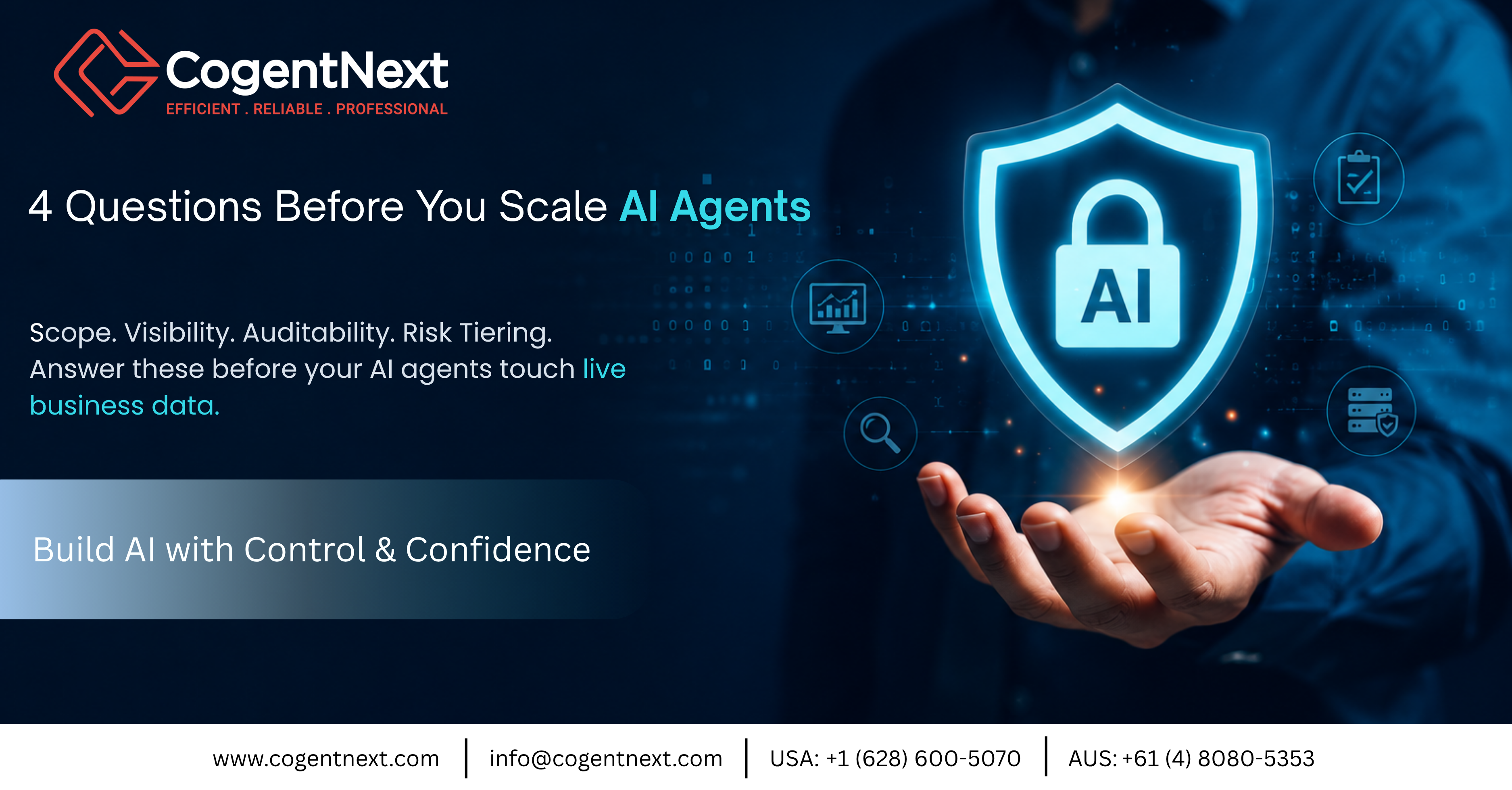
Before scaling AI agents across your ERP or CRM, a few foundational questions are worth answering:
- Scope: What specific actions is each agent authorized to take, and where does that authority end?
- Visibility: Is there a single place to see every agent running across the business, not just within one department?
- Auditability: Can you reconstruct why an agent took a specific action, after the fact?
- Risk tiering: Are higher-risk actions (payments, data changes, external communications) held to a stricter review standard than low-risk ones?
Enterprises that answer these questions upfront tend to scale AI agents with confidence. Those that don’t often end up governing reactively, after an incident forces the conversation.
Who Should Own This?
Agentic AI governance rarely fits neatly into one department’s job description, and that’s usually the first mistake. It cannot sit with IT alone, since business context (which actions are actually risky) lives with finance, sales, and operations leaders. It cannot sit with individual business units alone either, since that’s exactly how the siloed deployment problem starts.
The organizations managing this well tend to form a small, cross-functional governance group early, IT, finance, compliance, and the business owners deploying the agents (across Salesforce, Dynamics 365, or Oracle) so that scope, visibility, and risk tiering decisions are made once, consistently, rather than department by department.
A Practical Starting Point
You don’t need a fully mature governance program before deploying your first agent. A practical starting point looks like this:
- Start with one low-risk, high-volume process (like invoice matching or master-data cleanup) rather than a high-stakes workflow, so the guardrails can be tested before the stakes get higher.
- Log every action the agent takes, not just its outputs, from day one, even if no one reviews the log yet retrofitting an audit trail later is far harder than building it in from the start.
- Set a review cadence (monthly, at minimum) where the cross-functional group looks at what agents are doing, not just whether they’re working.
- Expand scope only after the first agent has run cleanly through at least one full review cycle.
This staged approach lets teams build governance muscle alongside AI adoption, instead of trying to design a perfect framework upfront and delaying deployment for months.
Signs the Gap Already Exists in Your Business
You may already have a governance gap without realizing it. A few common warning signs worth checking for:
- Different teams have enabled AI-driven automation features in your ERP or CRM independently, without IT or leadership tracking it centrally.
- No one can currently give a straight answer to “which systems can our AI tools write to, and which are read-only?”
- Copilot, Agentforce, or similar features were turned on by default during a platform upgrade, and no one has reviewed what they’re actually doing since.
- Vendor AI features get adopted because they’re available, not because a specific business case and risk review preceded the rollout.
If any of these sound familiar, the good news is the fix doesn’t require ripping anything out. It starts with visibility: a simple inventory of every AI agent currently live across your ERP and CRM stack, what it can access, and who owns it.
Frequently Asked Questions
What is agentic AI governance?
Agentic AI governance is the set of controls, an authority boundary, an audit trail, and risk tiering, that determine what autonomous AI agents are allowed to do inside business systems like ERP and CRM, and how those actions are tracked and reviewed.
Who should own AI agent governance in an enterprise?
It works best as a cross-functional responsibility, IT, finance, compliance, and the business units deploying the agents, rather than sitting with one department alone.
Which ERP and CRM platforms already run agentic AI?
Oracle Fusion Cloud HCM, Microsoft Dynamics 365 (via Copilot in Business Central and Finance & Operations), and Salesforce and Oracle NetSuite all run agentic patterns today across HR, finance, and CRM workflows.
How do we start governing AI agents without slowing down adoption?
Start with one low-risk, high-volume process, log every action from day one, and set a monthly cross-functional review cadence before expanding scope to higher-risk workflows.
The Bottom Line
Agentic AI is set to become a standard layer of enterprise ERP and CRM systems in 2026. The organizations that get the most value from it won’t be the ones that deployed fastest, they’ll be the ones that paired deployment with the right guardrails from day one. At CogentNext, we help businesses across India, Australia, and the US design ERP and CRM implementations where AI adoption and governance move together, not one after the other. If you’re evaluating AI agents inside Dynamics 365, SAP, Oracle, or Salesforce, talk to our team before you scale.
CogentNext Technologies
Get in touch with us:
Web: www.cogentnext.com
Email: info@cogentnext.com
USA: +1 (628) 600-5070
AUS: +61 (4) 8080-5353