
ERP Implementation Partner: Why Choosing the Right One Matters More Than the Software
The same ERP software can be delivered brilliantly or disastrously depending entirely on the partner behind the implementation. The software decision matters. The partner decision matters more.
The Decision Most Businesses Get Wrong
When organizations evaluate ERP systems, they spend most of their time comparing software: feature lists, pricing tiers, demo walkthroughs, analyst reports. That’s understandable — the software is visible, tangible, and easy to compare.
What gets far less attention is the ERP implementation partner, the team that will actually configure the system, migrate your data, redesign your processes, train your people, and support the platform after go-live. Study after study on ERP implementation outcomes points to the same conclusion: partner quality is a stronger predictor of project success than software selection.
Gartner research consistently shows that 55 to 75 percent of ERP implementations run over budget or over time. The root causes are rarely the software itself they’re scope mismanagement, data migration failures, change management gaps, and inadequate post-go-live support. All of these are partner execution problems, not software problems.
What an ERP Implementation Partner Actually Does
An ERP implementation partner also called an ERP consultancy, systems integrator, or reseller is a professional services firm that takes an ERP product and turns it into a working system for your business. Most ERP vendors, including Microsoft, SAP, Oracle, NetSuite, and Sage, sell software but don’t implement it directly. They rely on a certified network of partners to deliver the actual implementation.
In practice, that means your relationship with the partner is longer, deeper, and more consequential than your relationship with the software vendor. The partner is involved in:
- Requirements gathering – understanding your business processes, pain points, and objectives before any configuration begins
- Process design – mapping how your business will operate inside the new system, often redesigning workflows that have accumulated over years
- System configuration – setting up the ERP to reflect your chart of accounts, approval hierarchies, reporting structures, and operational workflows
- Data migration – extracting, cleansing, transforming, and loading years of historical data from your legacy system into the new platform
- Integration – connecting the ERP to your other systems: CRM, payroll, e-commerce, banking feeds, and third-party tools
- Testing – validating that the configured system behaves correctly across every scenario your business encounters
- Training – ensuring your team can actually use the system effectively before go-live
- Post-go-live support – resolving issues, refining configurations, and helping the platform evolve as your business changes
A software vendor gives you a platform. A partner gives you a working system. Those are very different things.
Why the Partner Often Matters More Than the Software ?
Consider two businesses implementing the same ERP same version, same license, same modules. One goes live on time, under budget, with strong user adoption. The other runs nine months over schedule, costs twice the original estimate, and ends up with a system the team uses reluctantly.
The software was identical. The partner was not.
Scope Management
ERP projects expand. Requirements evolve. Stakeholders add requests. A skilled partner manages scope proactively establishing clear change-control processes, helping the business distinguish essential requirements from nice-to-haves, and maintaining timeline integrity when pressure to add scope inevitably arrives. A weak partner says yes to everything and delivers nothing on time.
Data Migration Expertise
Data migration is where ERP projects most commonly run into serious trouble. Years of inconsistent records, duplicate entries, and non-standard formats don’t migrate cleanly into a new system without deliberate cleansing and transformation. Partners with deep data migration experience build this work into the project plan from day one. Partners without it discover the problem at go-live.
Change Management
Technology implementations fail when people don’t use the system. Change management communicating what’s changing, why it matters, and how it affects each team’s daily work isn’t a soft skill. It’s a project-critical discipline. The best implementation partners embed change management into every phase, not just the training sessions in the final weeks.
Post-Go-Live Capability
An ERP system at go-live isn’t a finished product it’s the beginning of a relationship between your business and the platform. Your processes will evolve. Regulations will change. New modules will become relevant. The right partner builds a long-term support capability, not a team that disappears after the go-live invoice is paid.
What to Look For in an ERP Implementation Partner
Not all partners are created equal, and the right partner for a 50-person manufacturing business isn’t the same as the right partner for a 500-person financial services firm. Here’s what matters most when evaluating implementation partners:
Platform Certification and Depth
Every reputable ERP vendor operates a certification programme for partners. Microsoft certifies Dynamics 365 partners across specific competencies. SAP certifies Business One and S/4HANA partners. Oracle certifies NetSuite and Fusion Cloud partners. These certifications are a baseline, not a guarantee of quality — but a necessary starting point.
Beyond certification, look for depth. A partner who has implemented 50 Business Central projects in your industry understands the edge cases, common pitfalls, and configuration decisions that generic partners miss.
Industry Experience
ERP configuration for a manufacturing business looks fundamentally different from configuration for a professional services firm or a distribution company. A partner with genuine industry experience doesn’t just configure the software — they bring pre-built process templates, industry-specific best practices, and familiarity with the compliance requirements your business faces.
References and Track Record
Ask for references from implementations of similar size and complexity to your project or review our client case studies directly. The right partner welcomes this; the wrong partner deflects. Speak directly with the client — not just the contact the partner selects and ask specifically what went wrong during the project and how the partner responded.
Team Stability
Large consultancies often win implementations with senior consultants in the sales process and deliver with junior staff. Ask specifically who will be on your project, their individual experience level, and the firm’s consultant turnover rate. Team continuity through a multi-month implementation is not a minor consideration.
Support Model After Go-Live
Understand exactly what post-go-live support looks like: response times, escalation paths, pricing model, and whether your dedicated implementation consultant remains involved or hands off to a generic support queue. Go-live is not the end of the project it’s the point at which your dependency on the partner increases.
Red Flags That Signal the Wrong Partner
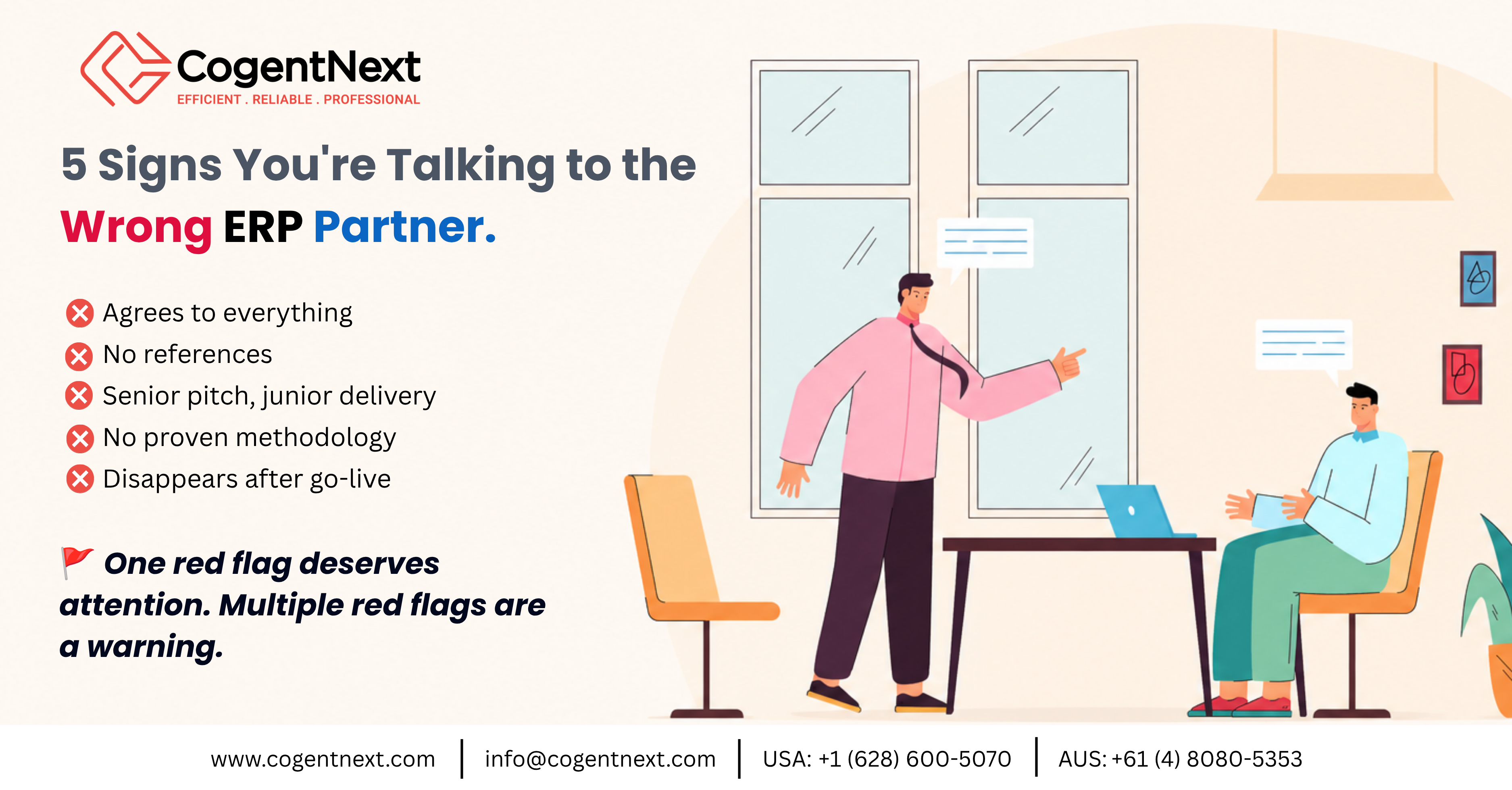
- Agrees to everything in the sales process – scope, timeline, and budget that seem unrealistically low. Firms that win business by underbidding make up the difference through change orders.
- Cannot provide references from implementations of comparable size, industry, or platform version to your project.
- Unclear about who will actually deliver the work – senior consultants in the pitch, junior staff on the ground is a pattern that consistently damages implementation outcomes.
- No structured methodology – partners who can’t clearly explain their implementation approach, change-control process, and testing framework are improvising rather than executing.
- Disappears after go-live – if the partner’s model is to complete the implementation and move on, you’re buying a project, not a relationship. ERP systems require ongoing partnership.
How CogentNext Approaches Implementation Partnership
CogentNext operates as a multi-ERP partner across Microsoft Dynamics 365, SAP, Oracle, NetSuite, Sage, and Salesforce, serving clients in Australia, the USA, and India. Our approach to implementation starts with a structured assessment of your current environment, business processes, and objectives before any software configuration begins.
We work with organizations at every stage from first-time ERP adopters moving off spreadsheets, to businesses upgrading from legacy platforms, to enterprises extending existing implementations with new modules or AI capabilities. Our certified consultants bring platform expertise and industry context to every engagement, and our support model continues well beyond go-live.
Contact the CogentNext team for an ERP implementation assessment and find out what a structured, partner-led approach to your specific project looks like.
Conclusion: Choose the Partner as Carefully as the Platform
The software you choose sets the ceiling on what your ERP system can do. The implementation partner you choose determines whether you ever get close to it. Before signing with a vendor, spend as much time vetting the team that will configure, migrate, train, and support the system as you spent comparing feature lists it’s the single highest-leverage decision in the entire project.
CogentNext Technologies
Get in touch with us:
Email: info@cogentnext.com
USA: +1 (628) 600-5070
AUS: +61 (4) 8080-5353