
From Legacy Systems to Intelligent Enterprises: A Practical Roadmap for 2026
In 2026, enterprises will not be competing on products alone. They will compete on intelligence; how quickly they can interpret data, automate decisions, adapt operations, and deliver personalized experiences at scale. Yet, many organizations are still anchored to legacy systems that were designed for a different era, one where stability mattered more than agility, and data was stored rather than activated.
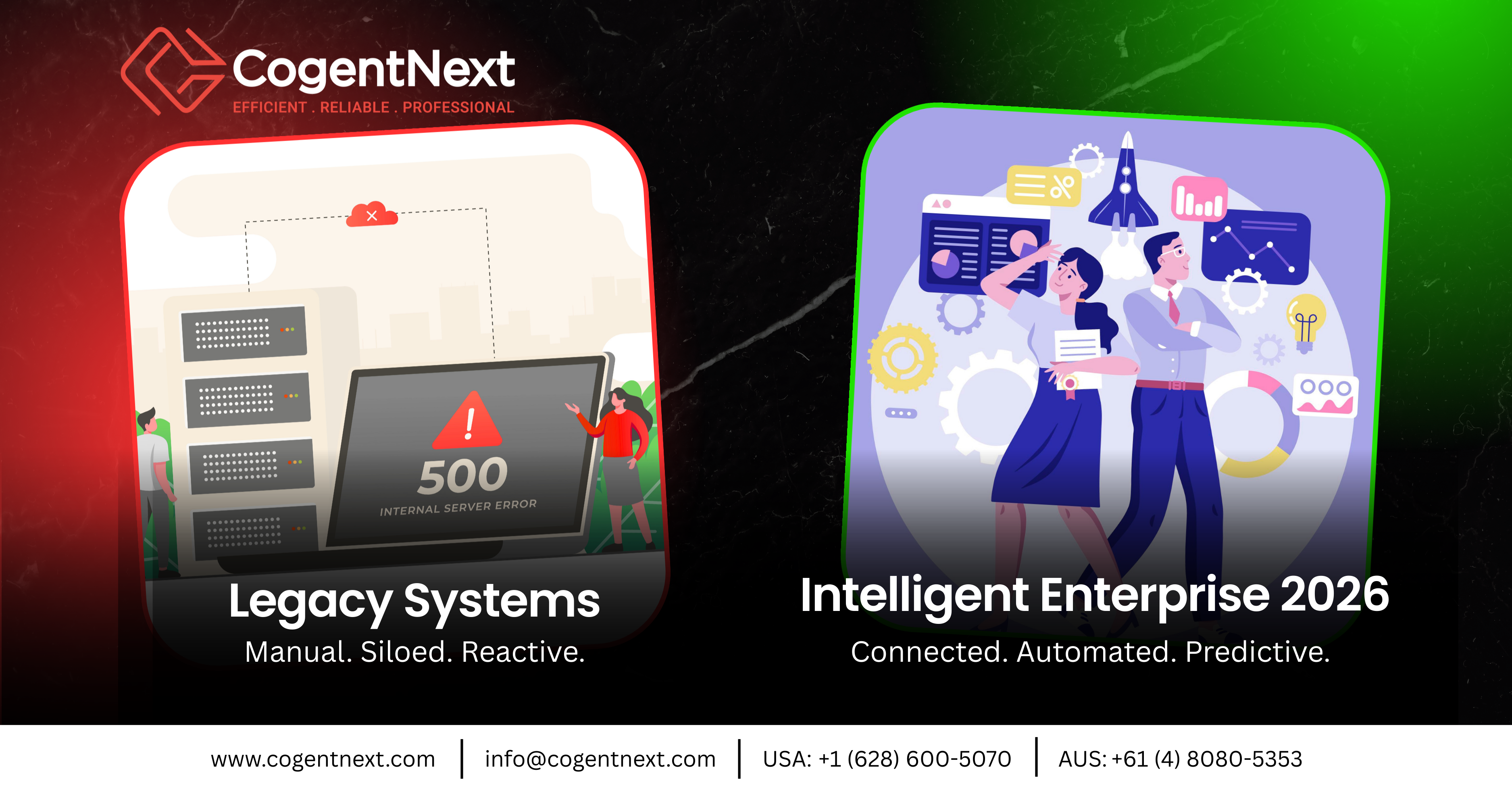
Legacy environments often consist of outdated ERPs, fragmented CRMs, on-premise servers, disconnected finance tools, spreadsheets managing critical workflows, and reporting systems that provide insights only after the fact. These systems may still function, but they silently drain productivity, slow down innovation, and create operational blind spots. The cost of maintaining legacy infrastructure is no longer just technical debt, it is strategic stagnation.
The shift from legacy systems to an intelligent enterprise is not simply a technology upgrade. It is a transformation in how an organization thinks, operates, and grows.
The Urgency of 2026: Why Modernization Can’t Wait
Markets are evolving at unprecedented speed. Customer expectations are rising. Regulatory environments are tightening. Global competition is intensifying. In this landscape, organizations that rely on delayed reporting, manual reconciliation, or siloed data structures cannot respond fast enough.
An intelligent enterprise, by contrast, operates on real-time visibility. It predicts instead of reacts. It automates instead of reconciles. It integrates instead of isolates. Most importantly, it scales without collapsing under operational complexity.
The real risk for 2026 is not adopting new technology. The real risk is standing still.
Phase 1: Establishing Strategic Clarity
The first step toward becoming an intelligent enterprise is not software selection but it is strategic clarity. Organizations must evaluate their digital maturity with brutal honesty. Which processes are heavily manual? Where do data silos exist? Which systems create bottlenecks between departments? How long does it take leadership to access accurate performance metrics?
Modernization without clarity leads to expensive patchwork. A practical roadmap begins with alignment between business objectives and technology architecture. Whether the goal is faster financial closing cycles, better sales forecasting, improved supply chain visibility, or enhanced customer experience, the transformation must be outcome-driven.
At CogentNext, transformation journeys begin with structured discovery engagements that map enterprise architecture, identify inefficiencies, and define measurable business KPIs before implementation begins.
Phase 2: Modernizing the Digital Core
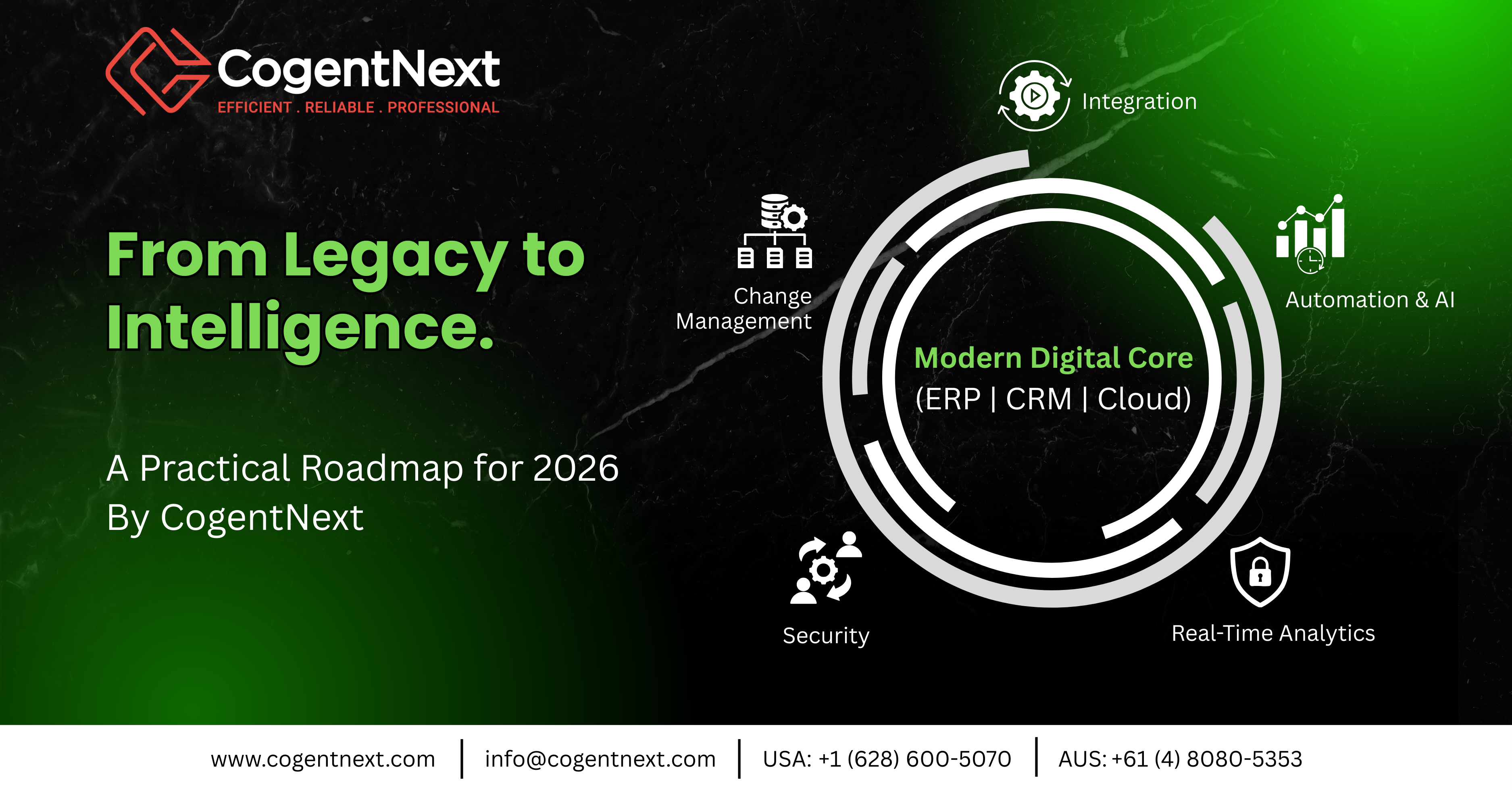
At the heart of every intelligent enterprise lies a modern digital core. This typically includes a cloud-enabled ERP and CRM ecosystem capable of real-time processing, embedded analytics, automation, and scalability.
Platforms such as SAP S/4HANA, Microsoft Dynamics 365, and Salesforce provide the foundational infrastructure for connected operations. Unlike legacy systems, these platforms are designed with API-first architectures, AI capabilities, and cloud scalability at their core. They enable finance, sales, operations, and supply chain functions to operate within a unified data environment.
However, modernization is not a lift-and-shift exercise. It requires thoughtful data migration, process redesign, integration planning, and change management. CogentNext, specializes in structured ERP and CRM modernization, ensuring seamless transitions with minimal business disruption.
Phase 3: Breaking Down Silos Through Integration
Many enterprises mistakenly believe that digitizing individual departments equates to transformation. In reality, digitization without integration creates new silos.
An intelligent enterprise connects ERP with CRM, HRMS with finance, supply chain with analytics, and operations with real-time dashboards. Unified architecture eliminates duplicate data entry, reduces reconciliation time, and ensures decision-makers operate from a single source of truth.
Through modern integration frameworks, middleware solutions, and cloud-native APIs, CogentNext designs scalable architectures that allow systems to communicate efficiently, securely, and in real time. Integration is what turns digital systems into an intelligent ecosystem.
Phase 4: Embedding Automation and AI
Once the digital foundation is modernized and integrated, the next leap is automation. In 2026, intelligent enterprises will automate repetitive tasks across finance, HR, procurement, customer service, and reporting functions.
Robotic Process Automation (RPA), AI-driven forecasting models, automated compliance checks, predictive maintenance algorithms, and intelligent workflow orchestration will significantly reduce operational overhead while increasing accuracy.
This is where enterprises move beyond digitization into intelligence. With its AI Services division, CogentNext enables businesses to embed intelligent automation into core operations, accelerating productivity and improving decision-making velocity.
Phase 5: Enabling Real-Time Intelligence
Traditional reporting models rely on periodic summaries: weekly, monthly, quarterly. Intelligent enterprises operate differently. They function on live dashboards, predictive analytics, and scenario modelling.
Leadership should be able to view revenue projections, operational bottlenecks, customer churn risks, and inventory forecasts in real time. Embedded BI tools such as Power BI, SAP Analytics, and Salesforce reporting environments empower executives to act instantly rather than wait for compiled reports.
CogentNext integrates advanced analytics frameworks that convert enterprise data into actionable intelligence, ensuring organizations do not just collect information, they operationalize it.
Phase 6: Securing the Intelligent Enterprise
As systems become more interconnected, cybersecurity and compliance must become central pillars of transformation. Cloud security architecture, identity and access management, data governance policies, and regulatory compliance frameworks must be embedded into the transformation journey from the beginning.
Security is no longer a back-office IT responsibility but it is a board-level priority. Intelligent enterprises are resilient enterprises.
CogentNext ensures enterprise-grade security, compliance alignment, and governance controls are integrated into every stage of modernization.
Phase 7: Managing Organizational Change
Even the most advanced technology fails without adoption. Digital transformation is as much about people as it is about platforms.
Training programs, leadership alignment, user adoption tracking, and process re-engineering are critical components of success. Employees must understand not only how to use new systems, but why they matter.
CogentNext supports organizations through structured change management strategies, ensuring transformation is embraced.
The Intelligent Enterprise of 2026
By 2026, leading enterprises will operate with:
• Unified cloud-based digital cores
• Real-time operational visibility
• AI-driven forecasting capabilities
• Automated workflows across departments
• Scalable, secure infrastructure
• Data-driven leadership cultures
These organizations will not merely react to market change — they will anticipate it.
Final Perspective
The journey from legacy systems to intelligent enterprise is not optional in 2026, it is inevitable. The only question is whether organizations will lead the transformation or struggle to catch up.
The roadmap is clear.
The technology is mature.
The opportunity is immense.
The time to begin is now.
Why CogentNext ?
Digital transformation requires more than implementation partners. It requires strategic architects who understand both business outcomes and technological complexity.
CogentNext brings deep expertise in ERP modernization, CRM transformation, intelligent automation, integration architecture, and AI-driven innovation. With a global delivery approach and industry-specific solutions, CogentNext enables enterprises to transition from legacy environments to intelligent ecosystems with clarity, confidence, and measurable ROI.
We do not just upgrade systems.
We design future-ready enterprises.
Let’s help you with this Practical Roadmap:
www.cogentnext.com
info@cogentnext.com
USA: +1 (628) 600-5070
AUS: +61 (4) 8080-5353