
NetSuite’s Autonomous Suite: What SuiteWorld 2026 Means for Your Finance and Operations Teams
Every ERP vendor talks about AI. At SuiteWorld 2026 in Las Vegas (October 25–28), Oracle NetSuite did something more specific: it described what an “autonomous suite” should actually do, and shipped part of it the same week.
If you run NetSuite today, or you are weighing it against other platforms, here is a plain-English read on what was announced, what you can use now and what to ask before you commit budget.
What NetSuite announced
The announcements sit on top of NetSuite Next, the AI-first layer of the platform. NetSuite’s pitch is a suite that understands business goals, notices what needs attention and takes action, while people stay in control. The main pieces:
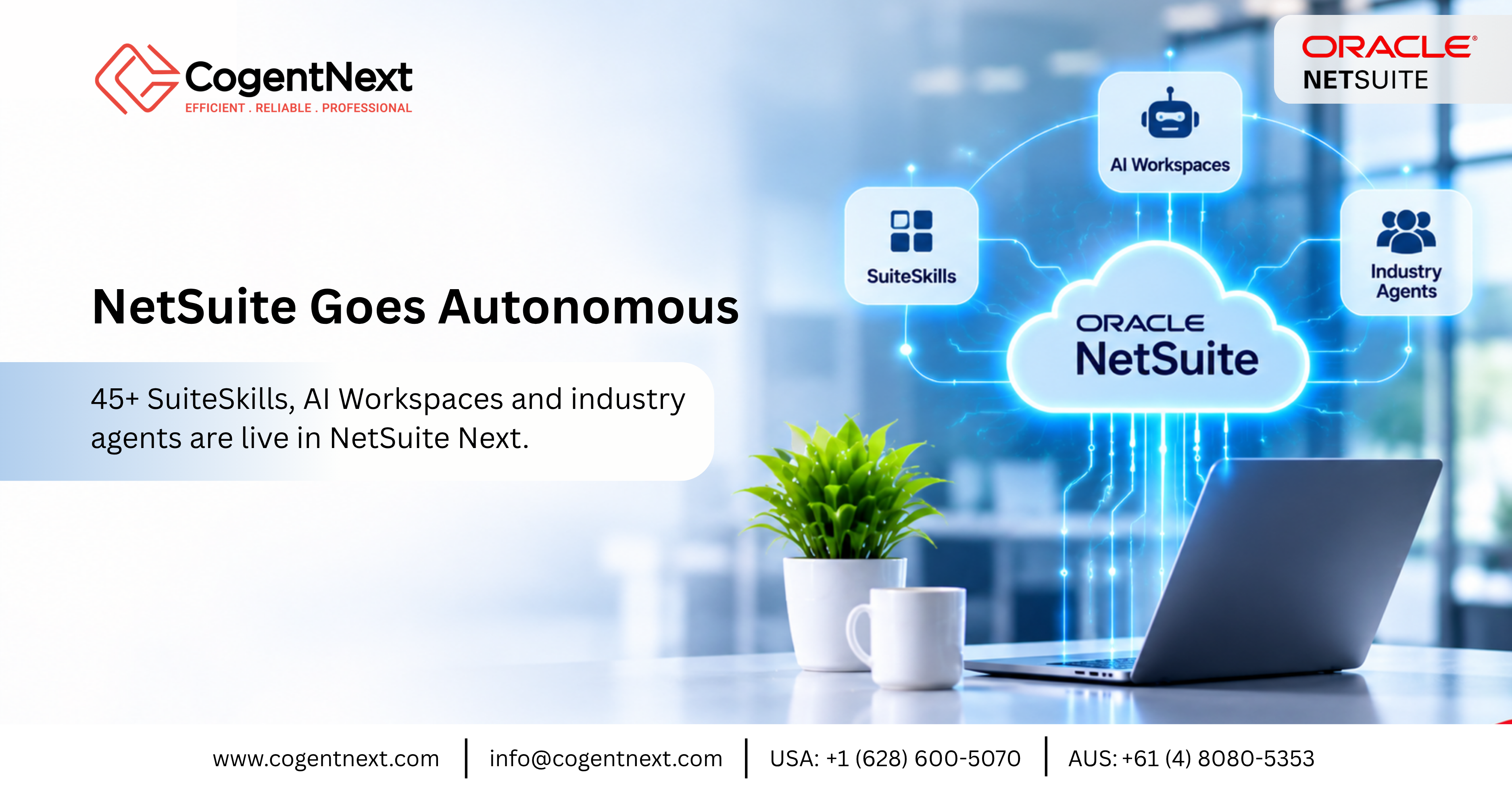
- SuiteSkills. More than 45 prebuilt business skills that pair NetSuite’s financial and operational data with AI reasoning. Examples include resolving issues that delay the financial close, spotting potential revenue leakage, and handling inventory and fulfillment exceptions.
- AI Portlets. Describe the dashboard you want in plain language and get the analysis, charts and available actions back. A finance leader could compare actual sales against a marketing proposal’s projections in minutes.
- AI Workspaces. One place where people, AI agents, information and approvals work together on a complex process. The first example is an Autonomous Close workspace.
- Industry-specific SuiteAgents. Agents built for software, healthcare, construction and nonprofit organizations, plus product businesses, targeting areas like revenue and grant compliance, inventory efficiency, supply risk and job profitability.
- SuiteAgent Studio and the SuiteFlow Agent. Tools to build your own agents and to create workflows by asking in natural language, with a review step before anything is created.
- SuiteAgent Management Workspace. A central place to manage what each agent can access and do, watch its activity and switch agents on or off.
- Ask Oracle updates. New connectors, including MCP client support, so users can pull in information from other business systems and direct permitted follow-up actions. NetSuite Analytics Warehouse is now NetSuite Data Intelligence.
What is available now, and what is not
This is the part that matters for planning. According to Oracle’s announcement, SuiteSkills, AI Portlets, AI Workspaces and select industry-specific SuiteAgents are available now in all markets where NetSuite Next is available. The remaining Autonomous Suite capabilities are planned for a future NetSuite release.
Oracle’s own disclaimer also says features, timing and pricing may change. So treat anything described in future tense, such as the Ask Oracle MCP connectors, as direction rather than a delivery date.
The idea worth paying attention to: zero-day close
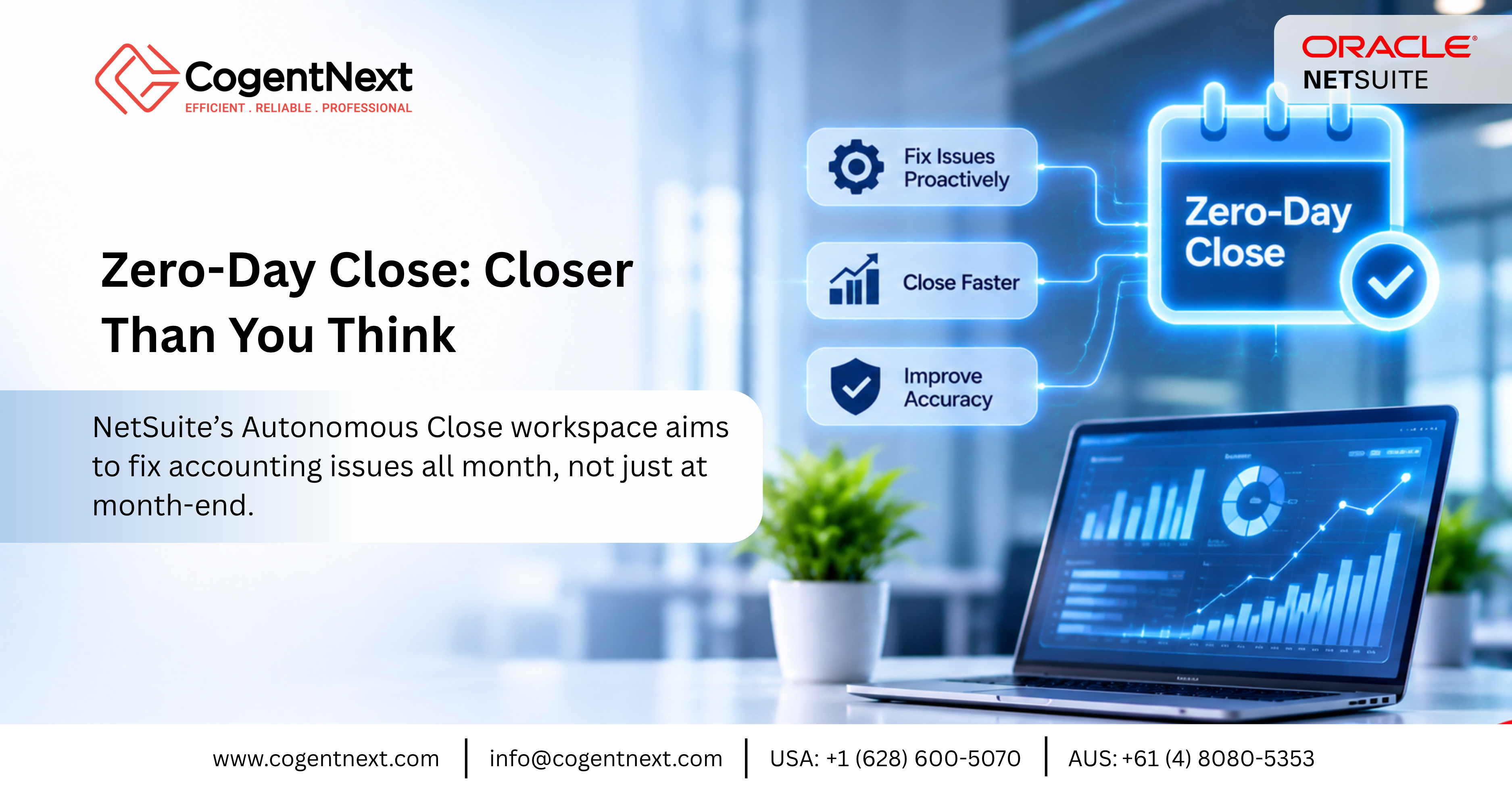
The Autonomous Close workspace is the clearest picture of where this is heading. Today, most finance teams find and fix accounting issues in a rush at the end of the period. NetSuite’s idea is for people and agents to identify and resolve those issues continuously, so the close is no longer a month-end scramble.
Zero-day close is an ambition, not a switch you flip. But the direction is useful for any finance leader: fewer late-period surprises, fewer manual reconciliations and more time spent on analysis.
Three shifts behind the headlines
- From screens to outcomes. Users describe what they need, and skills and agents do the clicking. Training shifts from “where is that menu” to “what should I ask for.”
- Governance runs through roles and permissions. Skills and agents act within the access your NetSuite roles already define. That is reassuring, but it also means messy roles become a bigger risk, not a smaller one.
- An open approach to AI. Customers can use NetSuite’s embedded AI or bring their preferred AI models through the NetSuite AI Connector Service, with the same permission controls.
Why this matters for mid-market businesses
NetSuite serves more than 44,000 customers, and many of them are mid-sized companies without large finance or IT teams. For them, the appeal of skills and agents is simple: more work done with the people they already have.
The Ask Oracle connectors show how that could work in practice. A user investigating a late payment could compare records across NetSuite and another connected system, review the supporting documents and then direct a permitted action, such as holding a payment or routing an approval. Today that usually means several logins, several exports and a few emails.
The trade-off is that the value depends on setup. Mid-market teams that clean up their data and roles first will get far more from these tools than teams that simply turn them on.
What it means for each team
- Finance leaders: Faster close, earlier warning on revenue leakage and quicker answers to “why is this number off.” AI Portlets also cut the wait for custom dashboards.
- Operations and supply chain: Inventory and fulfillment exceptions can be investigated and acted on from one place, instead of chasing records across saved searches and spreadsheets.
- NetSuite administrators: Agent management becomes a new part of the job. Someone needs to own which agents exist, what they can touch and who reviews their work.
- Executives: The real question is not “do we have AI” but “which processes will we trust it with first, and how will we measure the result.”
Where businesses usually get stuck
New AI features rarely fail because of the technology. They stall for ordinary reasons, and SuiteWorld’s announcements will be no different:
- Treating it as an IT project. Finance and operations own the processes, so they need to own the pilot too.
- No success measure. If you cannot say how many hours the close takes today, you cannot show that an agent improved it.
- Skipping change management. People need to know what the agent does, what it does not do and when to step in.
- Switching on too much at once. One process, one team and a clear review step will teach you more than a company-wide launch.
Five questions to ask before you act
Before you switch anything on, get clear answers to these:
- Are we on NetSuite Next? Availability is tied to it, so confirm your edition and market first.
- Is our data clean enough? AI that works across the suite is only as good as the records underneath: items, customers, vendors, chart of accounts.
- Are our roles and permissions tidy? If a role can see or change too much today, an agent working under that role can too.
- Which one process should we pilot first? Pick a painful, repeatable process, such as close exceptions or inventory issues, and measure it before and after.
- What will it cost? Ask your partner what is included, what is licensed separately and what may change as features move from announcement to general release.
A practical way to start
You do not need to adopt everything at once. A sensible first step is a short readiness review: your NetSuite version, data quality, roles and the two or three processes that cost your team the most time. From there, pilot one SuiteSkill or workspace, track the results, then expand.
Companies still moving to NetSuite, or planning an upgrade, have a bigger decision. The new capabilities are a good reason to plan the implementation around where the platform is going, not where it was a few years ago.
How CogentNext can help ?
CogentNext supports the full Oracle lifecycle, from implementation and upgrades to integration and migration, with certified consultants and 24/7 support for businesses across the U.S. If you want to know what SuiteWorld 2026 means for your NetSuite environment, we can help you separate what is ready today from what is still on the roadmap, and build a pilot that fits your team.
Ready to talk? Book a free consultation with CogentNext at cogentnext.com/contact-us.
Source: Oracle NetSuite press release, “NetSuite Advances Vision for an Autonomous Suite,” October 26, 2026. Features described are subject to Oracle’s future product disclaimer.
CogentNext Technologies
Get in touch with us:
Email: info@cogentnext.com
USA: +1 (628) 600-5070
AUS: +61 (4) 8080-5353