
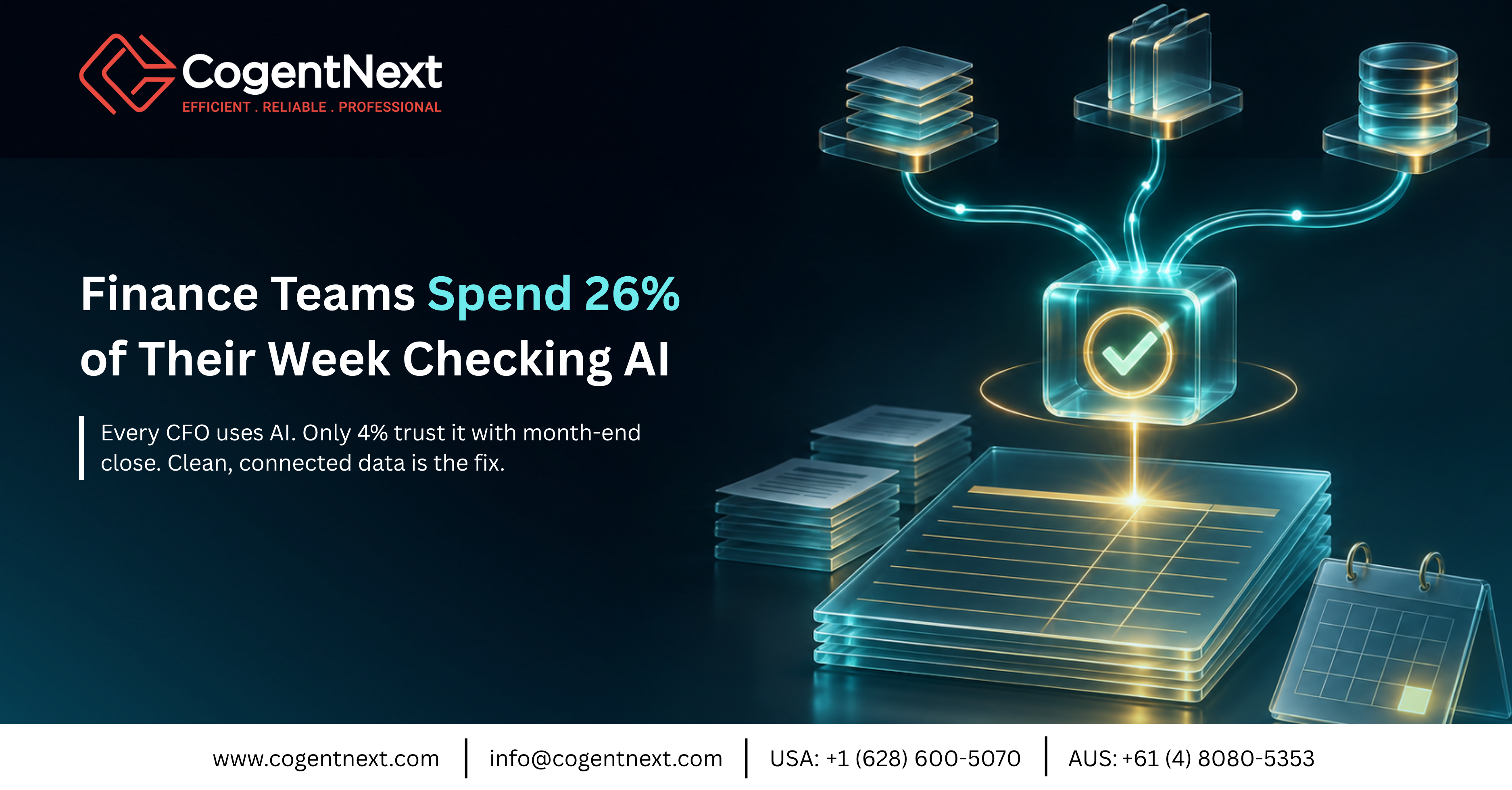
AI in Finance: Why Finance Teams Spend 26% of Their Week Checking AI
Every CFO now uses AI. That is the good news.
The less comfortable news: finance teams spend over a quarter of their working week, 26%, checking and correcting what the AI produces. That comes from the Datarails 2026 CFO Sentiments Survey, published on 6 October.
AI was meant to save time. For many finance teams, it has created a new job: verification. This post looks at why, and what to do about it.
The Numbers Behind the Headline
Datarails surveyed 270 CFOs and finance leaders. Here is what stands out:
- All of them use AI in some form for finance work.
- 96% spend at least 10% of their time verifying or correcting AI output. For 8%, it is more than half.
- Only 5% trust AI to produce board-ready reports without human review.
- Only 4% trust it with the month-end close.
- 76% feel high or very high pressure to implement AI fully. Just 7% say their finance function is fully ready.
- 32% overspent their AI budget by at least 10% in the past year, yet 53% plan to buy more licences.
The picture is clear. Adoption is universal. Trust is not.

Why Finance Teams Cannot Trust the Output
The survey names three reasons for hesitation:
- No audit trail (75%). Finance work must be explainable. If a number cannot be traced to its source, auditors will not accept it.
- Accuracy and hallucinations (71%). AI can sound certain and still be wrong.
- Regulatory and compliance worries (54%). Finance outputs carry legal weight.
Two daily frustrations make it worse. 65% of CFOs say AI often gives a confident answer based on the wrong data. And 56% say team members got materially different answers from the same prompt and the same data.
Imagine two analysts asking the same question and presenting two different revenue figures to the board. That is the risk finance leaders are guarding against.
The Root Cause Is Data, Not AI
Here is the finding we think matters most. Only 4% of organisations have a true single source of truth for finance and operational data. 73% say their data is mostly centralised. And 23% still rely on disconnected systems and manual reconciliation.
That last group suffers most. Among teams struggling with manual reporting and consolidation, 86% report confident answers built on the wrong data. Across all respondents, the figure is 65%.
The lesson is simple. AI reads whatever it is given. If your data sits in five systems with five definitions of revenue, the AI will blend them confidently and get it wrong.
This is where ERP and CRM teams have a head start. Clean master data, one chart of accounts and well-integrated systems are not new ideas. They are what makes AI trustworthy.
Start with Low-Risk Work, Then Move Up
Trust differs by task. In reporting on the same research, the Journal of Accountancy noted that more than four in five leaders trust AI to draft emails and summarise meetings without review. Fewer than half fully trust it with nine other tasks. Month-end close sits at the bottom, at 4%.
That gives you a natural ladder. Think of three tiers:
- Low risk: meeting summaries, email drafts, first-pass commentary. Light review.
- Medium risk: invoice coding, reconciliation suggestions, variance explanations. A named reviewer signs off.
- High risk: board reports, close tasks, regulatory filings. Full human review and a complete audit trail.
This is our view, not a survey result. But it matches how careful finance teams already work.
Good News: Jobs Are Changing, Not Vanishing
Two years ago, many expected heavy job losses in finance. The survey suggests otherwise. Only 3% of CFOs are cutting finance headcount because of AI. And 60% say they are redeploying people to higher-value work.
The new work is real, though. Someone must design the checks, own the data, and review the output. Finance teams that plan for these roles will cope better than those that treat AI as a plug-in.
Tool Sprawl Is the Next Problem
Finance teams now run an average of 2.5 general-purpose AI assistants. Microsoft Copilot is used by 93% of respondents, ChatGPT by 65% and Claude by 64%. Many teams use several at once.
That is useful, but it brings new questions. Which tool saw which data? Which version of the answer went into the report? Who approved the licence? With 13% of AI budgets having no clear owner, those questions often go unanswered.
The survey also shows a new category emerging. 32% of finance leaders are prioritising a finance operating system: a governed data layer built for AI. Only traditional planning and FP&A tools rank higher, at 42%.
You do not need a new product to follow the idea. You need one trusted place where finance data is cleaned, defined and permissioned, before any AI tool touches it.
What to Ask Before You Buy Another AI Tool
- Where does it get its data, and can we restrict it to approved sources?
- Can it show the steps and sources behind each answer?
- Will two people asking the same question get the same answer?
- Who in finance owns the licence, the cost and the risk?
- How will we measure time saved after review time is counted?
Six Steps to Cut Your Verification Burden
- Fix the data foundation. Agree one definition for key metrics. Remove duplicate records. Connect systems that should talk to each other.
- Feed AI governed data only. Point tools at approved, consolidated sources, not scattered spreadsheets. The survey notes that unrestricted LLMs often give different answers to the same question.
- Demand an audit trail. Choose tools that show their working: sources, steps and reasons.
- Tier your tasks by risk. Set the review level for each tier, and write it down.
- Name a budget owner. 13% of CFOs report that their AI budget has no clear owner. Spending without ownership leads to overruns.
- Measure verification time. Track hours spent checking AI. If that number does not fall, the tool is not saving time.
A Note on the Evidence
Be careful with any single survey. This one was run by Datarails, a finance software vendor. It covered US organisations with more than 1,000 employees and $100 million or more in revenue, and fieldwork was in July 2026. Smaller firms, and businesses in India or Australia, may see different numbers.
Still, the direction is hard to ignore, and it matches what we hear from clients: AI works best when the data underneath it is sound.
How CogentNext Can Help
CogentNext Technologies helps businesses in India, Australia and the USA bring AI into finance and accounting without losing control. Our team can:
- Assess your finance data and system landscape for AI readiness.
- Integrate your ERP, CRM and finance tools into one governed data source.
- Design approval, audit and review rules for AI-assisted finance work.
- Pilot AI on low-risk tasks first, then scale with confidence.
AI should give your finance team time back, not take it. Talk to CogentNext about building the foundation first.
Sources: Datarails press release, 6 October 2026 (2026 CFO Sentiments Survey); Journal of Accountancy, 22 October 2026; CPA Practice Advisor, 7 October 2026.
6. Recommended FAQs
What is AI in finance?
AI in finance refers to the use of artificial intelligence to assist with tasks such as analysis, reporting, reconciliation, forecasting and finance workflow support.
Why do finance teams need AI governance?
AI governance helps define approved data sources, user permissions, review responsibilities, audit trails and controls for AI-assisted finance work.
How can businesses improve AI accuracy in finance?
Businesses can improve AI accuracy by cleaning and connecting finance data, using approved sources, defining consistent metrics and keeping appropriate human review.
Can AI automate financial reporting?
AI can assist with parts of financial reporting, such as drafting commentary and analysing data, but high-impact outputs should be reviewed and approved by finance professionals.
Why is data quality important for AI in accounting?
AI outputs depend on the data supplied to the system. Inconsistent, incomplete or disconnected data can lead to inaccurate results.
How can ERP and CRM integration support finance AI?
Integrated systems can provide more consistent, governed data for finance processes and reduce manual reconciliation between disconnected applications.
CogentNext Technologies
Get in touch with us:
Email: info@cogentnext.com
USA: +1 (628) 600-5070
AUS: +61 (4) 8080-5353