
Oracle Fusion AI Agents in Finance: What to Automate First
Every finance leader running Oracle Fusion Cloud ERP is hearing the same pitch: AI agents are here, and they will transform the close. The harder question is the practical one. With so many processes that could be automated, where do you actually start?
Get the first move right and you build trust, free up your team and create a template for everything that follows. Get it wrong and you end up with a stalled pilot and a sceptical audit committee. This guide breaks down what Oracle has put into Fusion, how to choose your first use case, and how to roll it out without losing control.
What Oracle Has Built Into Fusion
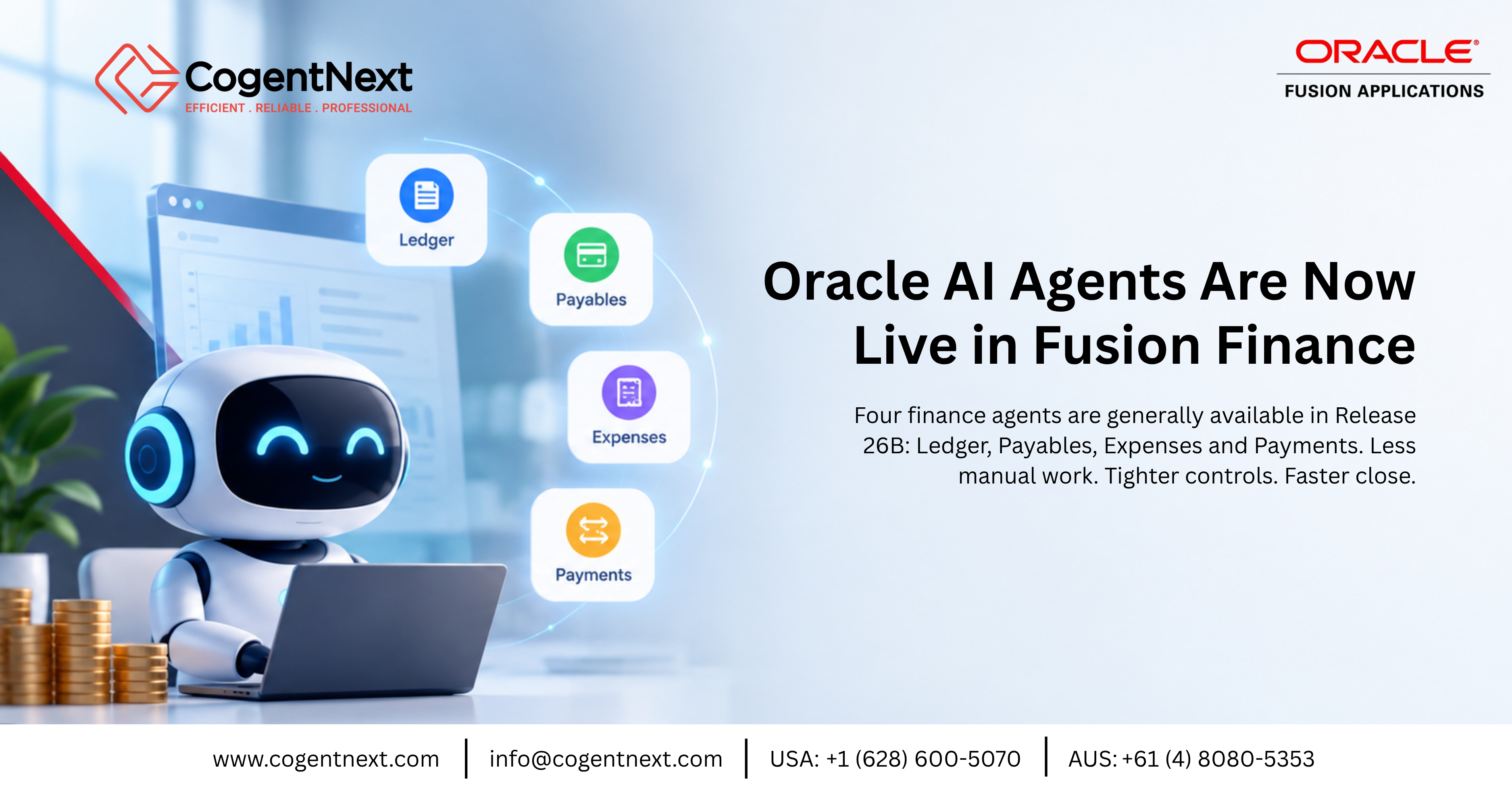
At Oracle AI World in October 2025, Oracle introduced AI agents embedded directly inside Fusion Cloud Applications. They are built with AI Agent Studio, run on Oracle Cloud Infrastructure and sit in the flow of work rather than in a separate tool. Since then they have moved from announcement to reality: Fusion Cloud ERP Release 26B made four finance agents generally available, covering the ledger, payables, expenses and payments. Two of them stand out for most teams starting out:
Payables Agent. Acts as a single intake for supplier invoices arriving by email, portal, EDI or PDF. It standardises the data, matches invoices to purchase orders and receipts, creates distributions and accounting, applies tax, policy and fraud checks, and routes the invoice for approval and payment.
Ledger Agent. Lets finance teams set plain-language watches over the ledger, explains what it finds with supporting detail, and can draft adjustment journals for review.
Expenses Agent and Payments Agent. Also generally available in Release 26B, these extend automation to expense submissions and to the final step of getting suppliers paid.
Beyond the prebuilt agents, AI Agent Studio allows customers and partners to build their own agents, or teams of agents, for processes unique to their business. Oracle states the embedded agents are included at no additional cost for existing Fusion customers, so it is worth confirming your own licensing position with your Oracle account team before you plan.
A Simple Test for Your First Use Case
Not every process is a good starting point. The best first candidates share three traits:
High volume – The benefit shows up quickly when thousands of transactions follow the same pattern.
Clear rules – If a human can explain the decision in a few sentences, an agent can usually follow it.
Contained risk – Mistakes should be easy to catch and reverse before they reach the general ledger or a bank account.
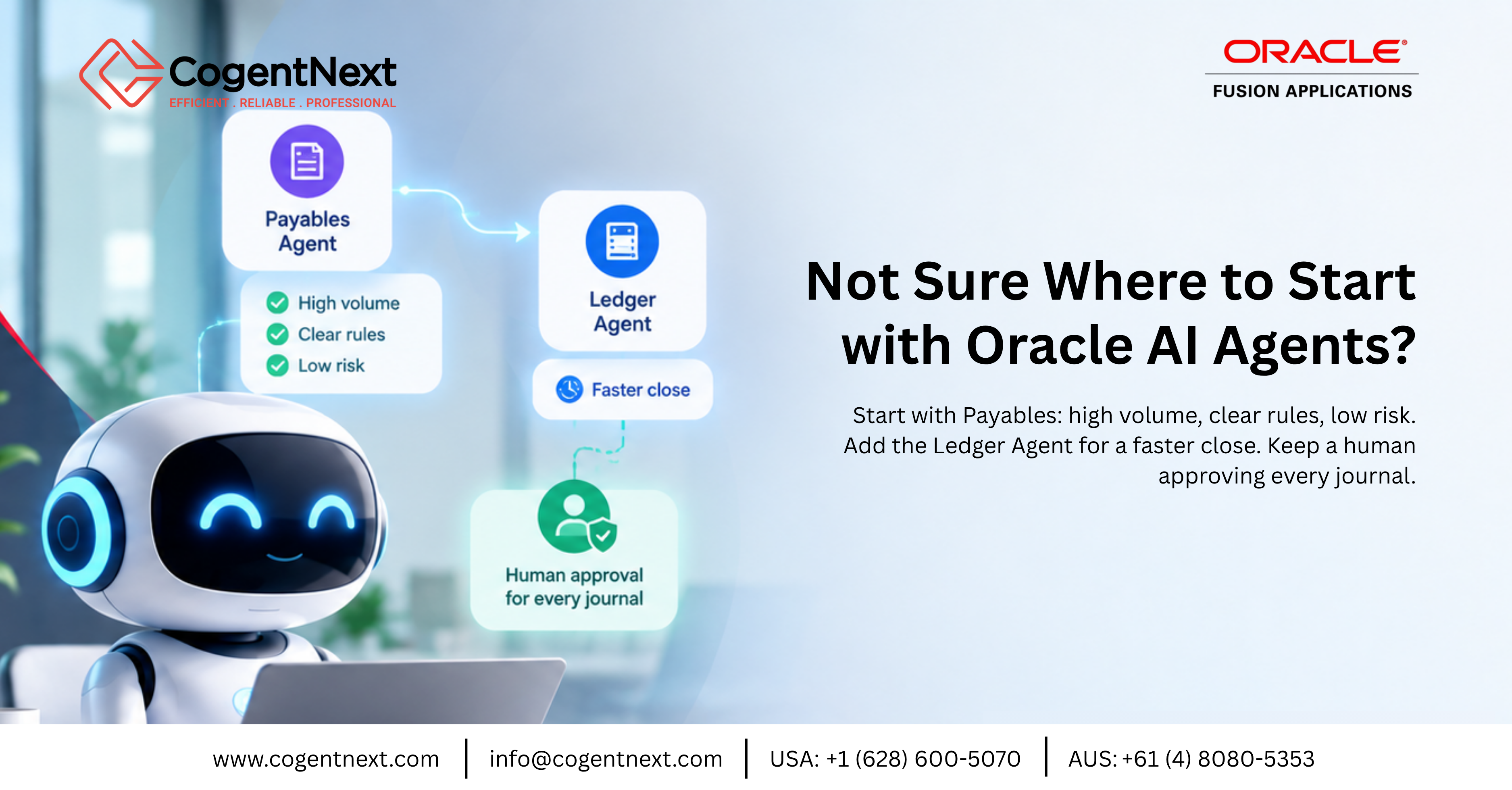
Run your candidate processes through those three filters and one tends to rise to the top: accounts payable.
Step 1: Start With Payables
Invoice processing is the classic automation target. It is repetitive, rules-driven and painful when it goes wrong. Late payments strain supplier relationships, duplicate payments leak cash, and manual keying invites errors.
The Payables Agent targets exactly this. Because it handles intake, matching, coding and routing in one flow, the realistic goal is higher straight-through processing: clean invoices pass with no touch, and your team spends its time on exceptions.
Before you switch it on, tighten the foundations:
- Clean up supplier master data, including duplicates, outdated bank details and missing tax information.
- Review your matching tolerances so the agent works to rules your team actually agrees with.
- Confirm approval hierarchies are current, since the agent will route work according to them.
Start with a single business unit or invoice type, measure the touchless rate and exception patterns for a few cycles, then expand.
Step 2: Bring In the Ledger Agent for the Close
Once payables is stable, the period-end close is the natural next target. Finance teams lose days to chasing unusual balances, reconciling differences and drafting routine adjustments. The Ledger Agent shifts that work from hunting to reviewing.
The key design principle here is to keep a human approving every journal. Let the agent surface anomalies, explain them and draft entries, but treat its output as a proposal. That keeps your segregation of duties intact and gives auditors a clear trail of who approved what.
Step 3: Build Custom Agents for What Is Unique to You
After the prebuilt agents prove themselves, AI Agent Studio opens the door to processes specific to your business. Think intercompany reconciliation rules, industry-specific accruals or supplier onboarding checks. This is where a partner earns their keep: good agent design means defining scope, guardrails, data access and escalation paths before a single line is configured.
Why Embedded Agents Matter
Many finance teams have tried bolt-on automation before, and the pattern is familiar: a separate tool, a separate login, a separate integration to maintain. Embedded agents change that equation. Because they live inside Fusion and work on the same data and security model, there is less to integrate, less to reconcile and fewer places for controls to break. For CFOs and controllers, that means faster adoption and a cleaner story for auditors.
It also means your Fusion release cadence matters more than before. Agent capabilities arrive through quarterly updates, so build a habit of reviewing release notes and testing new features in a non-production environment before they reach your finance users.
How to Measure Success
Agree on your measures before the pilot starts, so the results speak for themselves. A short, focused scorecard works best:
- Touchless rate – The share of invoices that flow from intake to payment with no manual handling.
- Cycle time – Days from invoice receipt to approval, and days to complete the period-end close.
- Exception volume – How many items need human attention, and whether the number is falling over time.
- Error and duplicate rates – Payment errors, duplicate invoices and post-close adjustments.
- Team capacity- Hours moved from keying and chasing to review, analysis and supplier management.
Share these numbers with finance leadership every month. Visible, early wins make it far easier to secure support for the next phase.
Governance: The Part You Cannot Skip
Agents act on financial data, so governance is not an afterthought. Build these controls in from day one:
- Role-based security – Give agents only the access they need, just as you would for a human user.
- Approval thresholds – Define what an agent can complete alone and what must go to a person, by amount, risk or supplier category.
- Audit trail – Make sure every agent action is logged and traceable for internal and external audit.
- Ongoing monitoring – Track accuracy, exception rates and overrides, and review them regularly rather than once at go-live.
A Practical 90-Day Roadmap
- Days 1 to 30: Assess data quality, confirm licensing and agent availability in your Fusion release, and select one payables scope for the pilot.
- Days 31 to 60: Run the Payables Agent in the pilot scope, track touchless rate and exceptions, and tune rules and tolerances.
- Days 61 to 90: Expand payables coverage, begin a controlled Ledger Agent pilot on one close cycle, and document governance for audit.
Common Mistakes to Avoid
- Automating a broken process – An agent will speed up a messy process, not fix it. Simplify first.
- Skipping change management – Teams that feel replaced resist. Show how the work shifts from data entry to review and analysis.
- Measuring nothing – Without a baseline for cycle time, error rates and cost per invoice, you cannot prove value.
- Going big on day one – Narrow pilots build confidence. Enterprise-wide launches build risk.
How CogentNext Can Help
At CogentNext Technologies, we help organisations across India, Australia and the USA get more from their Oracle investments. Our team can assess your Fusion environment, identify the right first use case, configure and test agents, and set up the governance that keeps finance and audit comfortable. Whether you are just starting to explore AI agents or ready to build custom ones, we can help you move with confidence.
What Is Coming Next: From Agents to Agentic Applications
Oracle is already looking beyond individual agents. Its Fusion Agentic Applications bring teams of specialised agents together to complete a whole business process rather than a single task. In finance, for example, agents in the Collectors Workspace review overdue balances and invoice aging to recommend priority actions.
For finance teams, the takeaway is practical. The organisations that start with individual agents today, with clean data, clear approval rules and strong governance, will be best placed to adopt these larger applications as they mature. Oracle AI World takes place from October 25 to 28, so expect more announcements soon, and review them against your Fusion release before you plan.
Final Thoughts
AI agents in Oracle Fusion are not about replacing finance teams. They are about taking repetitive work off their plates so they can focus on analysis, control and decisions. Start with payables, add the Ledger Agent for the close, build custom agents once the basics are proven, and keep governance at the centre throughout.
Ready to explore what Oracle Fusion AI agents can do for your finance team? Get in touch with CogentNext at info@cogentnext.com.
FAQ
What are Oracle Fusion AI agents?
They are AI capabilities embedded in Oracle Fusion Cloud Applications that can support specific workflows. The available capabilities depend on the product, release, configuration and licensing.
Which Oracle Fusion AI agent should finance teams implement first?
Accounts payable can be a practical starting point when invoice volumes are high, rules are clear, and exceptions can be reviewed safely.
How can Oracle Fusion AI agents help accounts payable?
Depending on enabled capabilities, agents may support invoice intake, matching, coding, checks and approval routing. Confirm the supported features for your Oracle release.
How can AI agents support the financial close?
Ledger-related capabilities may help identify unusual balances, explain findings and prepare proposed adjustments for human review.
What governance is needed for finance AI agents?
Use least-privilege access, approval thresholds, traceable audit logs, exception handling and regular monitoring. Keep human approval where required by policy.
How should a finance team measure AI-agent success?
Track touchless processing rate, cycle time, exception volume, error and duplicate rates, and staff time shifted to review and analysis.
Can CogentNext help implement Oracle Fusion AI agents?
CogentNext can assess the Oracle Fusion environment, identify a suitable pilot, support configuration and testing, and help define governance controls. Confirm the exact scope with the CogentNext team.
CogentNext Technologies
Get in touch with us:
Email: info@cogentnext.com
USA: +1 (628) 600-5070
AUS: +61 (4) 8080-5353