
Why “We’ll Upgrade Later” Is Your Costliest ERP Decision
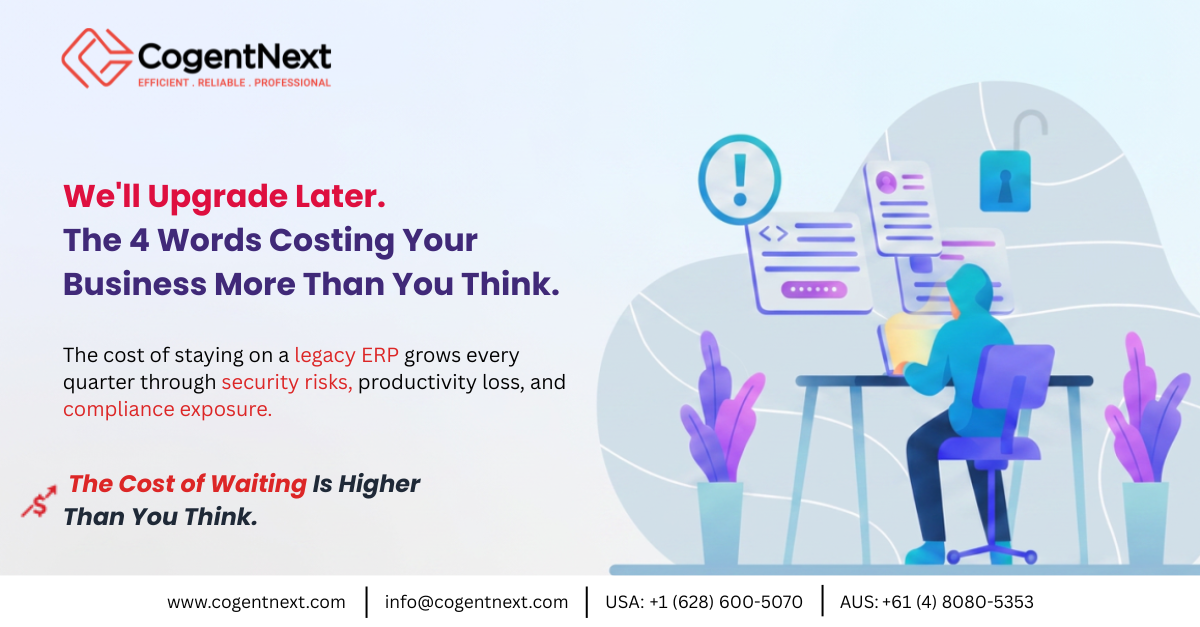
“We’ll deal with the ERP upgrade when the time is right.” That sentence has cost businesses more than almost any other decision in enterprise technology.
Quick summary: Delaying an ERP upgrade doesn’t preserve the status quo it compounds risk every quarter across security, compliance, productivity, and competitiveness. Gartner research shows more than 70% of IT budgets go toward maintaining legacy systems instead of driving innovation, making “later” one of the costliest words in ERP strategy.
The Logic That Feels Right But Isn’t
Delaying an ERP upgrade often feels like the safest choice the system still works, and delay avoids the cost and disruption of change. But staying on a legacy ERP isn’t free. Maintenance costs, security risks, and productivity losses continue to grow over time. Research from Gartner and Forrester shows that 70–80% of IT budgets are spent maintaining legacy systems instead of driving innovation, making the cost of doing nothing higher than many organizations realize.
The Six Real Costs of Waiting
1. Security Risk That Grows Every Quarter
Every quarter you run an unsupported or under-patched ERP, the attack surface widens. Legacy ERP systems lack modern security architecture they weren’t built for today’s threat landscape. When vendors stop issuing security patches, that gap becomes permanent.
The ERP holds your financial records, payroll data, supplier information, and customer history. A breach in an aging system isn’t just a technical incident it’s a regulatory, financial, and reputational event. And the longer the delay, the higher the exposure.
2. Productivity Losses Nobody Measures
Legacy ERP creates friction that teams learn to live with: spreadsheet workarounds, manual data re-entry between systems, reports that take days instead of minutes, approval processes done by email because the system can’t automate them.
Research shows that modern ERP implementations reduce manual errors by 70%. Organizations running outdated systems are leaving that efficiency on the table every single day not as a visible line item, but as a slow drain on the hours, accuracy, and energy of every person who touches the system.
3. Compliance Exposure That Only Gets Worse
Tax regulations, payroll rules, financial reporting standards, and data privacy requirements change constantly. Modern ERP platforms receive regulatory updates automatically. Legacy systems do not.
For businesses operating in Australia, the USA, or India all markets where CogentNext operates the regulatory landscape is active. ATO reporting requirements, US state payroll compliance, and data privacy obligations all depend on systems staying current. An ERP that’s stopped receiving regulatory updates isn’t just inconvenient it’s a compliance liability.
4. The Customization Trap
Every customization added to a legacy ERP makes the next upgrade harder. Custom code must be retested, rewritten, or revalidated with every new release. Over time, this customization debt compounds to the point where an upgrade feels nearly impossible not because it is, but because the accumulated complexity has made it feel that way.
5. The Widening Capability Gap
Every month a business stays on a legacy ERP, its competitors on modern platforms are doing more with less: AI-powered forecasting, autonomous accounts payable, real-time financial dashboards, natural language querying of ERP data. These aren’t future capabilities they’re standard features in current ERP releases from Microsoft, SAP, Oracle, and NetSuite.
Delayed modernization doesn’t maintain the status quo it widens the gap. And by 2026, that gap is measurable in operational efficiency, decision speed, and customer experience.
6. The Talent Problem
The people who built and maintain legacy ERP systems are retiring or moving on. Consultants who specialize in unsupported platforms are a shrinking pool. Support contracts for older ERP versions become more expensive as fewer vendors are willing to service them.
Organizations that wait too long find themselves in a double bind: their system needs support, but the expertise to provide it is increasingly scarce and increasingly expensive.
The Honest Case for “Later” And Why It Still Doesn’t Hold
There’s a legitimate counterargument to ERP urgency. Gartner predicts that by 2027, more than 70% of recently implemented ERP initiatives will fail to fully meet their original business case goals, with as many as 25% failing catastrophically. These are real numbers that any CFO should factor in.
But this data argues for better planning, not indefinite delay. Organizations that face ERP implementation failure typically rushed the project, underestimated customization complexity, or failed to manage change. The solution to ERP implementation risk is structured, well-advised migration not avoiding it until the system becomes a liability.
The question isn’t whether to upgrade. It’s whether to upgrade on your terms or under pressure. Businesses that plan early choose the timing, the pace, and the partner. Businesses that wait have those choices made for them.
How to Know When “Later” Has Already Become “Now”
Most organizations already know their ERP is overdue for modernization. Here are the clearest signals that the conversation needs to happen immediately:
- Your team uses spreadsheets alongside the ERP to fill gaps in functionality or reporting
- Month-end close takes longer than it should because data needs to be manually reconciled across systems
- Your ERP version is no longer receiving regulatory updates, security patches, or vendor support
- Integration with modern tools, payment systems, e-commerce, CRM, BI requires expensive custom connectors or workarounds
- New employees find the system difficult to learn and frequently ask for workarounds
- Leadership can’t get real-time operational visibility without waiting for manual reports
If three or more of these apply, the cost of staying is already exceeding the cost of change. The decision isn’t ahead of you it’s already overdue.
How CogentNext Can Help ?
CogentNext works with businesses across Microsoft Dynamics, Oracle, SAP, NetSuite, Sage, and Salesforce to assess ERP environments honestly not to sell an upgrade, but to show what the current system is actually costing and what a structured modernization path looks like.
We start with a structured ERP assessment: your current version, customization footprint, integration dependencies, compliance exposure, and total cost of ownership. That assessment gives leadership the information they need to make a real decision not one based on assumptions or vendor pressure.
Contact the CogentNext team for an ERP readiness assessment and find out what your current system is actually costing your business.
The Bottom Line
“We’ll upgrade later” is not a risk management strategy. It’s a cost deferral that compounds interest every quarter in security exposure, productivity loss, compliance risk, customization debt, and widening competitive disadvantage.
The businesses that modernize on a planned timeline consistently outperform those that wait for a crisis to force the decision. The cost of a well-planned ERP modernization is fixed and knowable. The cost of standing still is hidden, growing, and often larger.
Later always costs more than now.
CogentNext Technologies
info@cogentnext.com
USA: +1 (628) 600-5070
AUS: +61 (4) 8080-5353